I sometimes watch ads for products and services and I’m not sure whether to laugh myself silly or be appalled. It’s going to take more than Miracle products to have a perfect garden like those made for TV. It’ll take a real miracle: the Second Coming of Christ.
Yes, more than advertized rescue inhalers will be needed to rescue African violets planted in an outdoor flower bed next to kalanchoes and cyclamen. Even garden center ads show this very same thing. Obviously none of these people garden in the real world where houseplants want to stay in the house instead of flaunting audacity; laughing in the face of destruction, and throwing down the gauntlet for a gang of aphids.
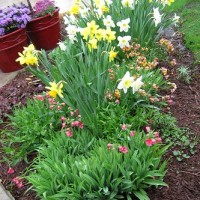 Real world gardening involves everything being beautiful its time (Ecclesiastes 3:11).
- Things bloom. Things seed.
- We sow. We harvest.
- We plant good seed and get weeds.
- Gardening has its seasonal ups and downs.
News flash: my garden isn’t perfect. I have real world gardening.
Gardening in a world marred by sin means that we have had the cloudiest April on record but the upshot is renewed compassion for friends in Seattle with their rainy days. In Chicagoland, rain and cool means we’ll have real world rot, a world of leaf diseases, and really happy slugs.
Despite the battles against the thorns and thistles outside of Eden (Gen 3:18), I rather like the challenges that each year brings. It keeps life interesting and spurs me to creative problem-solving. Every year, I try something different and even if I didn’t, the weather conditions rarely present themselves as ideal for the same things. I go back to the drawing board anyway.
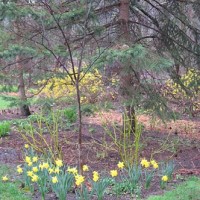 Even in the midst of dreary days, perennial features such as the cheerful yellow forsythia, “Cardinal” red-twig dogwood, and King Alfred daffodils lift one’s spirits.
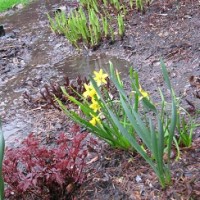 And look at the beautiful range of colors of emerging growth of turtlehead (Chelone obliqua), Astilbe ‘Fanal’, and hostas—all of which tolerate standing water for short periods. Good thing, since in every real world garden a little rain must fall. This particular garden is always among the last to be worked because it is a low spot in our yard. I find that working our higher front yard to the lowest back is always helpful since that’s how things aren’t worked when it’s too wet. Working the soil when it’s wet ruins the structure. Mulching when it’s raining causes the ground to retain the soggy conditions longer. It’s important with conditions like these to research carefully what plants will survive in such Out of Eden locations.
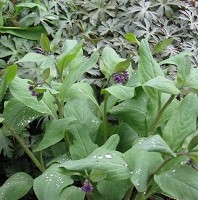 My bluebells (Mertensia virginica) are budding and my native cranesbill geranium (Geranium maculatum) won’t be outdone. Also in my woodland garden are lily-of-the-valley (Convallaria majalis) and sweet woodruff (Galium odoratum) which are not native but escaped cultivation and are real showstoppers. I like that phrase: escaped cultivation. Makes them seem like garden rebels…or too beautiful to be held captive.
Gardening in the real world: creative ups and downs. Cultivation and escape. Adversity and beauty. It doesn’t get any better than this. Until Jesus returns, that is.
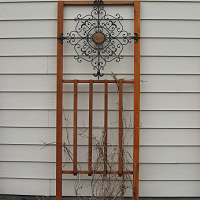 Since it’s early spring, I know now is the perfect time to make the change and to provide new garden structures. Originally, I bought some wrought iron wall art that I was going to hang on the wall and pull the clematis vines up to the ornamental plaques. But then, I began to think about rust stains developing on my siding and decided to consult my neighborhood Home Depot for better options instead.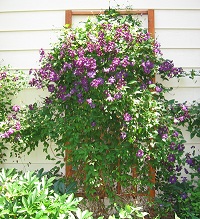
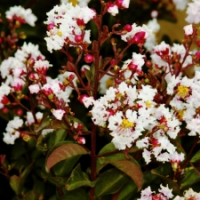 Some of my plants are still hiding in the garage awaiting better weather: a lovely ‘Burgundy Cotton’ Crape Myrtle which I brought back on the airplane from Texas and some ornamental grasses that I use in pots. They are not hardy here, so I consider my garage to be more of a hardiness zone like Arkansas.
 I think there’s something of the splendor of God in every emerging sprout, the jiggle of the earthworm, and the singing of the cardinals. I love spring.
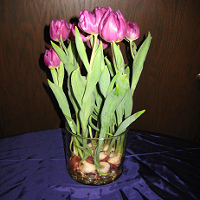
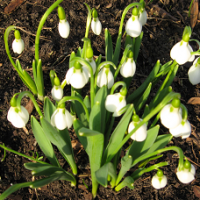 The snow isn’t completely gone from my yard, but my early spring bulbs (which are late this year because of snow cover) are coming up. Snow crocus, snowdrops, winter aconite are among my favorites for cheering the heart. Soon, the chinodoxa and daffodils will be blooming in warmer microclimates in my yard. Not all the daffodils will flower outside though–some will come indoors to bloom.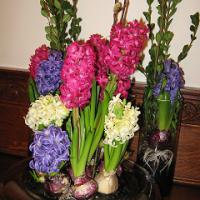
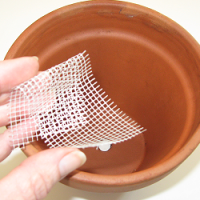 I’m continuing to start seeds indoors. I try not to start them so early that they become leggy before planting season. Knowing the last frost date for my area of USDA zone 5 is May 15, I back-calculate to determine what seeds to start on any given week.
 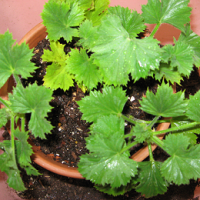 Martha Washington geraniums are cool season bloomers, but will continue blooming into the summer if sheltered from heat or full sun locations. I took cuttings when I brought them in last fall which served 2 purposes: (1) it made the mother plant smaller and (2) provided ample stock for multiplying quantities. I do the same with coleus which are easily started from cuttings. I grow stock plants through the winter under lights, take cuttings for new plants, and harden them off when planting season arrives.
 I thank God for everyone whose life has forged my Christian walk. I am grateful for so many women including wives of the men whose names appear here and the ways you have stood by my side. Ladies, your encouragement and support I have never doubted. You know who you are and what a blessing you have been to me!