When God Says It’s Judgment Time

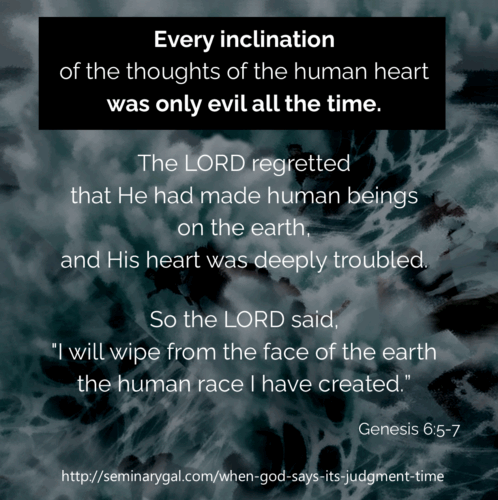
By now, the Bible depicts an abundance of wicked Not My People and only a handful of My People. Sometimes God has no choice but to judge. It’s not a democracy or majority rule. God is King and Judge, not just Creator. It’s a last resort, for sure, but Judgment is the one thing that curbs evil every time. The bottom line for you and me is to endeavor to be My People because it always ends badly for Not My People.
Questions for further reflection:

A cute depiction of the ark with cuddly animals isn’t the picture God had in mind.  He intended a massacre of every one of Not My People. No sane parent would decorate the baby’s room with Texas Chainsaw Massacre.  Why do people diminish the horror of the Flood and the total elimination of Not My People, but instead, give us cute and chubby baby animals safe in the ark, even for people well above adolescence? 

I’m not a wet blanket. Go ahead, decorate the baby’s room, but be sure to correct the record when they come of age.  Teach them what really happened in the Flood…to explain what the rainbow really means.

Noah (a descendant of Seth) and his family (8 in all) become the remnant of My People although Noah’s wife and his sons’ wives are not named so we have no idea if they were from Seth’s clan or from among “Not My People.” One thing we can say for certain is that every one of those 8 carried beyond Noah’s Ark their inherited sin nature that began in Adam. Yeah, Noah did too.

Even so, the choice remains before every man, woman, and child: follow God or don’t.  Be My People as a remnant or Not My People as wanderers to Destination: Hell. 

Think about Cain, Able, and Seth. How does God’s choice of a Remnant mean we cannot rely on our parents’ or grandparents’ faith?

Continue Reading

Biblical Cycles and Forever Paths

Last time, we saw that God provided for Himself a Remnant to be called My People.  But God’s choice to go with a Remnant doesn’t absolve God’s people from dire consequences when they don’t act like My People.

Within the forever path of My People, expressed through a series of Remnant after Remnant, there are cycles of Judgment to remind God’s people of their responsibility to act like My People.

Adam and Eve found that out.  Make one really bad choice to sin and suddenly, My People in Eden became Not My People in the Garden. 

Even after they tried to resume acting like My People who worship God, their two kids find a fork in the road and show it with their offerings to God.  One heads down the path of murder, embarking upon restless wandering away from God’s presence, and the other one (who gave his best to God) was killed by his brother Cain, ending his line.

But then God provides for Himself a Remnant of My People in Seth.
This is a historical pattern we see time after time. 

God doesn’t force Himself on people who don’t want Him. Not My People who form the hardened branch of the family tree never resume being a whole branch sprung from My People.  Once they choose idolatry and rebellion against God, the branch becomes spiritually dead to Him.

Now, of course, the Bible has examples of isolated people from a genetic branch of Not My People whose hearts, by God’s grace, remember their Creator. Notable examples include Ruth and Rahab (who are in the lineage of Christ), and in the New Testament, famous examples of Gentiles like Luke, Cornelius, Lydia, and even Timothy whose father was a Gentile.

In whatever manner they come to be My People, when they rebel, they will experience cycles of favor, judgment, and restoration.  It’s how God purifies His People.  Ultimately “Adam” and “Eve” (My People) will be restored to the New Garden in Revelation 22 with many cycles of favor, judgment, and restoration along the way. 

Questions for further thought:

Is the world presently trending toward a state of favor, judgment, or restoration?

Think about nations (the Americas, European, Israel, etc.).  Are they in equivalent places along that cycle?

Aside from the Flood (which we’ll look at next time), how does God often use the enemies of My People (those who are Not My People) to inflict God’s purifying judgment? Read Jeremiah 1:13-16 for insight.

How is a return to the land evidence of God’s favor upon His people as He brings His plan to fruition in the Last Days?

Continue Reading

Not My People, Not My Remnant

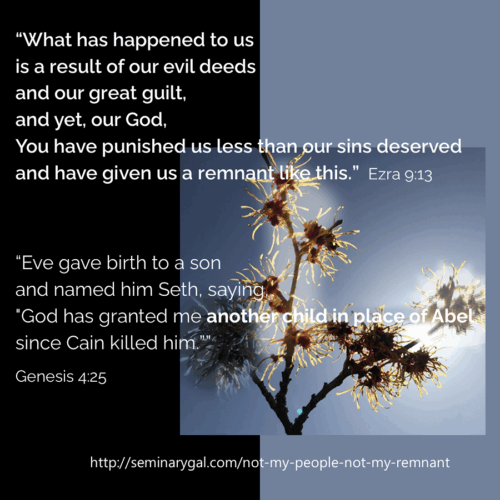
God gave Himself a new Remnant, instead of using the Cain branch left over after Cain murdered Abel. The Cain branch was Not My People, Not My Remnant because Cain didn’t revere God or listen to His call to do what was right. Cain doubled down on sin, murdered his brother, so he and his descendants were made restless wanderers from the presence of God. Seth and his descendants, while also having an inherited sin nature, would choose instead to call on the Name of the Lord and be restored to My People status.

We will see, time and again, that My People always get preserved
and restored in due season.

Questions for reflection:

A time goes on Cain, and his descendants, go from bad to worse.  Seth and his descendants present a return to calling upon God.  How do these two sons of Adam display the choice any man has and the ramifications of that choice upon future generations?

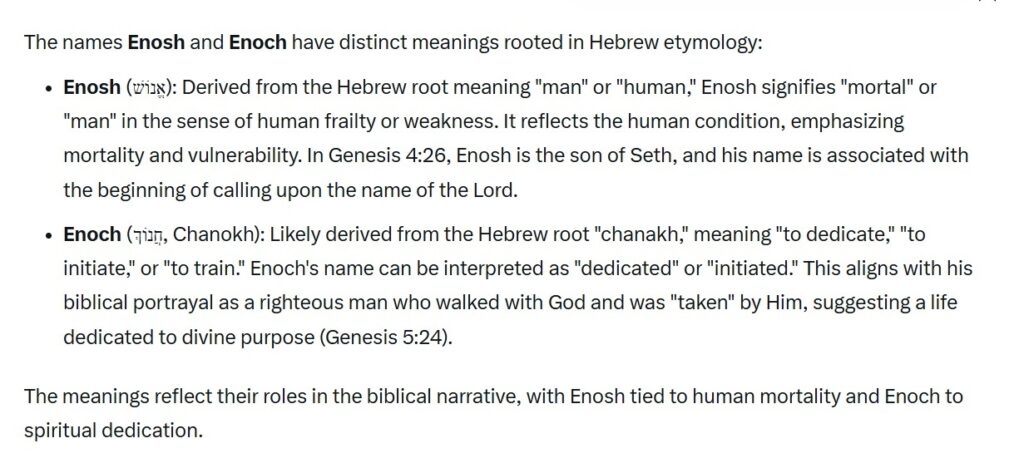
Look at this chart.  Consider the meanings of the name Enosh (humanity’s son of Seth, grandson of Adam) leading to Enoch (generations descended from Seth), a man who walked with God and never died.  How does God always preserve a remnant to walk faithfully with Him? In my series on the Remnant I asked, “Why might Eve, the mother of all living, have associated the third-born Seth with being in place of Abel, her second born who was killed? In what ways might redemption already be in the picture? Why does redemption focus on the remnant and not promote the trunk of a family tree?” Seth’s line would continue to Abraham, the great patriarch.

By focusing only on the trunk of the family tree (Adam or Abraham, etc.), we can fall prey to such moral equivalence between My People and Not My People.  In that Remnant series, I also asked considering Seth and other children of Adam, “Wait, you might say, how do I know other sons of Adam didn’t form the remnant too?  Noah.  Stay tuned for Luke 3:36.” Yeah, we’ll get to Noah, too, and God’s decisiveness about My People/Not My People. They are not the same.

Continue Reading

The Land and Not My People

After God confronted Cain with the murder of his brother, God issued a punishment.

‘Not My People’ are always restless.

Cain said to the LORD, “My punishment is more than I can bear. Today You are driving me from the land, and I will be hidden from Your presence; I will be a restless wanderer on the earth, and whoever finds me will kill me.” 15 But the LORD said to him, “Not so; anyone who kills Cain will suffer vengeance seven times over.” Then the LORD put a mark on Cain so that no one who found him would kill him. 16 So Cain went out from the LORD’s presence and lived in the land of Nod, east of Eden.” Cain made love to his wife, and she became pregnant.” (Genesis 4:13-17, underline mine)

And away from the Lord’s presence, Not My People go from bad to worse.

Questions for reflection:

How does evil spread, whether culturally or generationally?

Can mankind be trusted to police itself apart from God’s presence? Did Cain demonstrate he couldn’t master sin before being sent away?  Would he be likely to master it now, having been sent away from God’s presence? As the world drifts from God, can we expect things to get better or worse?

Think back to the curse in Eden.  Adam and Eve (created in God’s Image) were judged, but not cursed.  The land was.  Why?

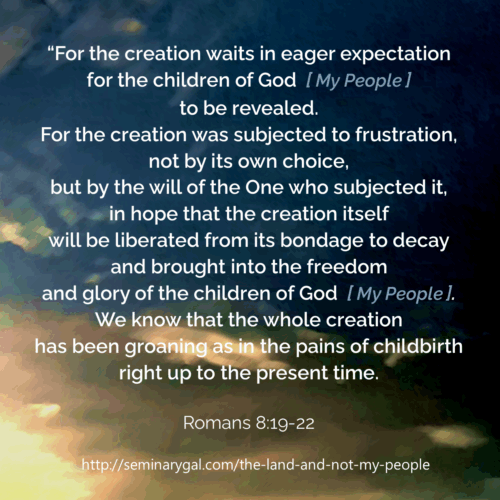
It’s not just Adam and Eve and their progeny who faced the punishment for sin.  All of creation did. 

Look back at the Scriptures and see the connection between My People (Adam and Eve) versus Not My People (Cain and his descendants) with respect to the land, to the ground, to God’s presence, and to restless wandering.  Why do you think the land is so important to various groups in the Middle East?

Continue Reading

Not All Children are the Same

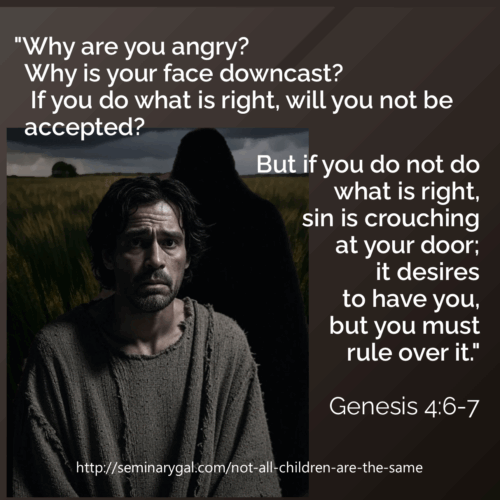
After expulsion from Eden, Adam and Eve had kids.  One of those kids was “Not My People” and his actions caused strife with those who were more like “My People.”

Cain did not read the memo about how God’s people worship God and display His likeness. 
God’s People act like they’re made in God’s likeness. 
Cain did not.  Abel did.

It’s not a case of unfairness where God is choosing favorites because Abel won the Chopped Champion competition with a better tasting meal.  Nope.  God saw that Abel gave God the best he had as an act of worship.  Cain “phoned it in” and went through the motions of worship but all the while harboring secret sin of keeping the best for himself.  He had a different god in mind.

Questions for reflection:

Why would Cain be angry?  Who does he think is God in this relationship?  What does that tell you about his heart?

Presumably they had the same upbringing, and they certainly had the same parents.  What would make Abel “My People” and Cain “Not My People”?  What makes you different from your siblings?

How do “Not My People” often react to “My People”?  Sin left to fester, will.  What happens next?

Bring that thought to our modern world with modern Israel.  Within the Middle East, how do “Not My People” react to “My People” (whether Christians or faithful Jews)?  

How does antisemitism herd all Jewish people into the Not My People camp whether God-fearing or not?

Continue Reading

Get Out and Don’t Come Back

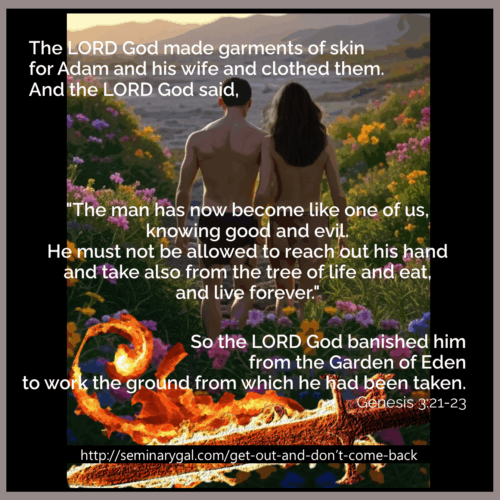
Probably the first instance of My People who experienced the Judgment of God and became Not My People were Adam and Eve.  At the start, they had it all, the quintessential My People. They’d been made in the Image of God, with His clear commission to multiply His Image, His holiness, His love, everything wonderful about God throughout all of Eden!  It would be a testimony to the land, to the Created Order, and to Adam’s and Eve’s offspring of the true and loving nature of God.

It’s a fearsome responsibility to know that for every instance in which you can affect someone for good, the potential is always there to harm someone, too.  Adam and Eve disobeyed the God who loved them and created them. All of creation witnessed their listening to Satan instead of obeying God.   

It was sin, and because God’s Image is not that of sin, they no longer reflected God’s Image perfectly.  In God’s eyes, therefore, they went from being My People in Eden to Not My People to remain in Eden.  Out you must go. And don’t come back, because you can’t. Once a sinner, there’s no going back.

It doesn’t mean that God stopped loving them.  It means they stopped worshiping Him alone and honoring Him.  They could no longer be trusted with the privilege of stewardship of Eden, importantly of the tree of life which would allow them to live forever because now, their forever would be a state of disobedience and idolatry.  They were sent away for their own good.

Reflection questions as we continue this study:

How is being sent out of Eden a foretaste of disobedient Chosen People becoming Not My People who many years later end up enslaved, exiled, or sidelined as God works His Judgment through other nations? 

Did God leave the Israelites enslaved in Egypt, exiled in Babylon, or was there a time of redemption as He brought them back to be a nation?

God made Adam and Eve more suitable clothing (Genesis 3:21) than just fig leaves, and in Judgment, He sent them away.  How are both indicators of God’s grace and ongoing love?

How does an out of context snapshot of Adam and Eve getting evicted fail to capture the grace undergirding that moment or the redemption God planned through the offspring (seed, Messiah) who would come?

If we look at modern Israel as a snapshot instead of a movie on pause, how does our view change of God’s Chosen People and God’s continual grace and love?

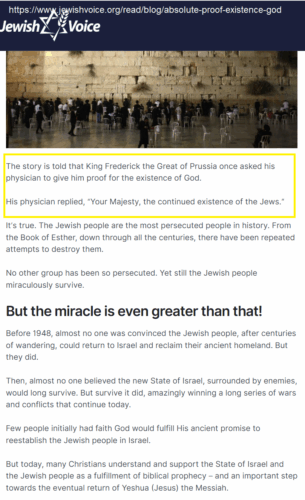
It has been said that the ongoing remnant of the Jewish people testifies to the existence of God.  In what ways would that be a true statement?

Continue Reading

Restoration for Not My People

In Hosea, God continues showing how Israel has been unfaithful to Him, much like the adulterous Gomer was unfaithful to Hosea.  But God is not like man, not even a “lover-not-a-fighter” person who loves like Hosea does. 

God is in the restoration business, something no human can do. He delights in restoring Not My People to My People status.

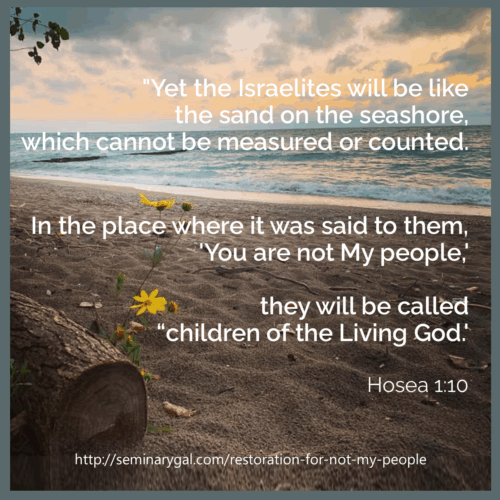
Importantly, God doesn’t judge to harm, but to call people home.  God sends judgment SO He can restore a repentant people.  He even points that out to Hosea:

We’ll come back to this (particularly the language of “children of the living God”) but it’s worth pointing out three things. 

First, these biblical times are not unlike our own.  It was a time of political and economic success that almost inevitably produces people who rely on themselves and forget God.  That’s why their times and also ours are itching with idolatry, spiritual failure, and moral corruption which breaks out as unrest and rebellion against God. Oh, maybe it’s hidden under the surface, but it’s still there … even if looking good on the outside. 

Surface neatness hiding the junk drawer. Inside, they ignore God at best and hate Him at worst.  God finds that hypocrisy and idolatry disgusting.

Second, Hosea wasn’t given a choice in message only a call to be faithful to God, or not.  The only person I feel sorrier for than Hosea who was forced to marry a prostitute would be his poor kid who has a prostitute for a mother and shows up on the first day of school, introduced to the class as “Not My People.”  God sure has an odd way of making His point.

And “what point was that?” you ask.  Unfaithfulness on the part of the “Chosen People” Israel angered and pained God.  It brought about harsher judgment because they had been God’s “Chosen People” and had turned their backs on Him.

They were intended to be a light to the nations (Isaiah 42:6-7), but instead, they led the way in unfaithfulness.  That cannot go unchecked.  (Ironically, that’s precisely why NO Christian should be an anti-Semite because that leads the way in our unfaithfulness as the light of the world–Matthew 5:14-17.)

But third, God’s grace abounds all the more.  His amazing love astounds us. He still wants our redemption.  Even after all that, His purpose is to call us home, to remembering, honoring, and loving Him…whether Christian…or Jew. Never forget that.

Reflection questions as we continue this study:

How would God asking Hosea to marry someone who is unfaithful be a prophetic sign-act and not Hosea’s sin?

Why would God give a living picture to display in human terms how God feels betrayed by Israel? 

What types of things do we do that anger God?

If you’re a Christian, how is your treatment of the Jews seen by God as your treatment of His Messiah?  (See Matthew 25:31-46)

If God still loves and desires to restore the Jewish people, is anti-Semitism (the devil’s orchestrated propaganda campaign in our present culture) ever going to be okay with God?

If God loves them and forgives them when they repent, who are we to question the Living God?

To be continued…

Continue Reading

My People, Not My People

Today, let’s begin a new series exploring who exactly are “God’s people?”  Some might argue that it’s Christians.  Others might point to the Tanakh (Hebrew Bible/Old Testament) and say, “It’s the Jews.” 

What comes next?  Rapid finger pointing at maps and history books, Al Jazeera or the New York Times headlines, geopolitical realities, etc., and then chaos completely drowns out an actual discussion or learning anything helpful to this enduring problem in the Middle East.  One thing I can say for sure, “the Church” has not replaced “the Jews” (Romans 11:19-23). Rather there’s been a divine pause until the full number of Gentiles have been included.  But we’ll get to that later.

For now, Hosea, one of the minor prophets, has something to say about My People, Not My People.  Enough, in fact, that he named one of his kids “Not My People” … but we’re going to see in this study, that the concept of “My People, Not My People” goes all the way back to Genesis and will continue to the very end of time.

[Uh-oh.  Sounds like Judgment…Not My People]

Reflection questions as we approach this study:

Is the modern state of Israel God’s people, a mixture of God’s people and Not My People, or Not My People at all?  What characterizes each group?

What is the Christian’s response to the obvious and worldwide rise of antisemitism orchestrated by Satan? Do you think Satan especially hates the Jews or all people equally? Why do you think that is?

Has God stopped loving My People? If you have 26 minutes to watch or listen to Christian podcast host Carl Jackson discussing this topic with Ashkenazi Jewish author and podcaster Josh Hammer. They ask, “Can You Love America and Hate Jews?” Given what’s going on in American culture, it’s a very serious question.

What was God’s rationale for asking Hosea to marry a prostitute and naming a son “Not My People”?

Modern evangelical America risks becoming fractured over the very question “Who are God’s people?” and its natural follow-on (what does it mean to be God’s people?). Where do you stand on this question? Do you consider “the Jews” to be enemies, friends, or a mixture of both?

To be continued…

Continue Reading

The Lasting Fruit of Love

The Christian’s purpose in life is to bear lasting fruit of faith and love.  This next passage points that out and is a fitting conclusion to our look at “By Their Fruit.”

Abide in Christ, produce His fruit.
The Christian’s entire “purpose driven life” is stated in verse 16-17. 
If you’re a Christian, you’ve been appointed.  Be faithful.  Just do it. 
It’s your calling to love others as Jesus loved you.

The fruit that lasts is love, the visible evidence in our actions of our heart’s hidden faith.  You may have heard the song, “They’ll know we are Christians by our love…” or have heard that we can only bring 3 things into heaven: our testimony, our works of love, and other people who became disciples.  Any other fruit may disappear when our work is tested by fire.  Your job? Gone. Your investments? Gone. Your home decorating, cooking blog, or Etsy handiwork? Gone. Your exotic cars, your luxury wardrobe, your career?  Gone!  The earth? Gone!  

Yet, if social media is any indication, most people’s work won’t survive.

Years ago, I was on a platform called “AllExperts” answering people’s questions about the Bible and the Christian life.  One day, out of nowhere the new owners obliterated the entire site. There was no way to go back to retrieve or archive my eighteen years of work that people searched and valued.  It was gone. In a flash. I was devastated. 

But then, I prayerfully adopted a different view.  You see, all I have today on earth to show for that season (on this side of heaven) are the handful of people from around the world who I met there and still count as friends.  When the Day brings my work to light, these people stand as testimony of my work.  It partially explains why I value them so much.

So what about you?  What will withstand the fire of testing as your lasting fruit of love?

Continue Reading

Kinds of Fruit

We don’t really have an out like Dorothy in the Wizard of Oz. When Glinda asks, “Are you a good witch or a bad witch?” Dorothy replies, “I’m not a witch at all. Witches are old and ugly!” If only the world presented evil people as visibly old and ugly. (It doesn’t.) Satan himself masquerades as “an angel of light.” (2 Corinthians 11:13-15). The world continually deceives us into thinking of shades of gray goodness when God’s Word portrays good vs. evil as very much black and white.

In recent days, Dan Bongino (formerly a podcast host and Secret Service Agent) and now Deputy Director of the FBI startled many with this post on X.


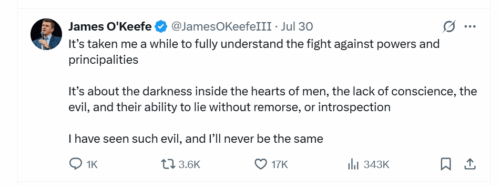
What “shocked [him to his] core” is likely the same thing that James O’Keefe (formerly of Project Veritas) mentioned as amplification within days.

There are two groups I’d like to discuss with respect to fruit, deceivers both…and the types of people that Bongino and O’Keefe likely encountered as they discovered the intensity of a spiritual battle before them.

First, there are those who look perfectly good on the outside but are rotten to the core. The same kind who can commit evil, atrocities even, with a smile on their face with a firm and friendly handshake that doesn’t hint at the evil within. What O’Keefe refers to as the lack of conscience and darkness in men’s hearts. It’s not just the hate mail, rage posts, and death threats that display an ugliness in the soul seeping through a highly polished exterior. No, it’s the evil in its purist form that remains hidden. Only when one ventures close enough can one sense it: the evil that remains hidden to visibility but is felt unmistakably in the spiritual realm. Yes, that’s the kind of moral betrayal that shakes one to his core, and after seeing its reality, one is forever changed in his views of good and evil. It’s this spiritual darkness that we do battle against as Christians.

Second, however, are those who are supposed to produce good fruit, but through a lack of abiding, and a lack of faithfulness, or through downright betrayal, they’re barren instead. They seem so benign, but they deceive as well. They are the Christian pretenders whose good fruit is not evident beyond, perhaps, some token bits. On one extreme, there are columnists, for example, who identify as Christian but out in the public square, they proclaim a very different message and side with the devil every chance they get. On the other extreme, there are the proclaimers of Christ who secretly betray us. Somehow, we’re still surprised when a Christian leader turns out to have committed great evil against his flock, his frock, and his God.

Each of those is the Judas in our midst, the same dark heart that would share in Jesus’ ministry but betray Him in the end. Sad to say, the devil still has his servants working in the world, producing evil fruit wherever they go, but managing to hide behind the smile, the pat on the back, the power, position, or prestige, and the fellowship of what portrayed itself as friendship. Only to be a betrayer of trust, a betrayer of Christ.

Remain vigilant, my friends. The battle is upon us. Bear fruit for Christ. Understand the times, and don’t let evil surprise you or shock you to your core. It’s more real … and black and white than we know on this side of heaven.

Continue Reading