No Shame for the New Nature

No amount of good works we do can provide us with a new nature.  This was a hard lesson for me.  There was pride involved in doing all the good I could to distract from the sinner Scripture says that I am. 

I didn’t feel like a big sinner. 
I wasn’t an axe murderer, terrorist, con-artist, grifter, thief or anything. 
In fact, I was a “pretty good” person doing “pretty good” things. 

But no amount of good works covers that horrible trifecta:

sin, guilt, and shame. 
It was part of my nature as a member of the human race.

And so, I struggled with shame.  It’s still a weak spot for me because my heart desires perfection but I will not be perfect on this side of eternity. Only in heaven will it be so.

Before Christ and His work on the Cross, we had routine blood sacrifices of animals.  They substituted for us—in flesh—as a placeholder.  But when Jesus came, lived, was Crucified, and rose from the dead, there was a fundamental change of process for us. 

No more goats or sheep.  No!  Now we could be “born again” by the power of the Holy Spirit.

It’s a hard concept to be sure.  But it is essential to understanding the profound consequences of Jesus’ Crucifixion and His Resurrection. 

Think about this high privilege bestowed by our Lord upon a Pharisee when Jesus tried to explain it ahead of time to Nicodemus who came to Jesus at night.  Under the cover of darkness, Nicodemus stated,

“John 3:2 “Rabbi, we know that you are a teacher who has come from God. For no one could perform the signs you are doing if God were not with him.”

3Jesus replied, “Very truly I tell you, no one can see the kingdom of God unless they are born again. “

4″How can someone be born when they are old?” Nicodemus asked. “Surely they cannot enter a second time into their mother’s womb to be born!”

5 Jesus answered, “Very truly I tell you, no one can enter the kingdom of God unless they are born of water and the Spirit. 6 Flesh gives birth to flesh, but the Spirit gives birth to spirit.”   (John 3:1-6)

It’s the new birth—through the Holy Spirit—that gives us a whole new nature and the power to live the Christian life.  This isn’t a flesh birth or a flesh death.  Jesus’ body was Crucified, resurrected, and He appeared to His disciples as the Risen Lord. That was His human body, but His spirit was always untouched. Think about it: our bodies still look the same after deciding to follow Christ, but the Christian’s spirit has been born again to a whole new nature.

“Born again” is a phrase that is often derided, but it is truly life-changing in its significance. Spirit gives birth to spirit–and means there is another realm we now experience.  We can live like it–free from sin, guilt, and shame–but will we?

Continue Reading

Shame and the Amazing Exchange

Jesus was no whipping boy or scapegoat.  There’s far more going on here than punishment which happened when He took away our sin (which was both the offense and the point source of all our guilt and shame). 

Here’s the key: we don’t just start with a clean slate, as good news as that is.  Yes, our sin got “imputed” to Christ, and God accepted His sacrifice.  That’s the clean slate and it never needs to be repeated (Hebrews 1:3, 7:17-8:1), which is in itself amazing…

But, here’s something more glorious:
there’s an exchange possible
only because He is God Incarnate and He identified with us! 

God made Him who had no sin to be sin for us, so that in Him we might become the righteousness of God. (2 Corinthians 5:21)

By our faith in Him and His redemptive work, we’ve already received forgiveness for our sins, are able to reject our own moral agency through the power of the Holy Spirit, and then, His righteousness gets imputed to us in return.

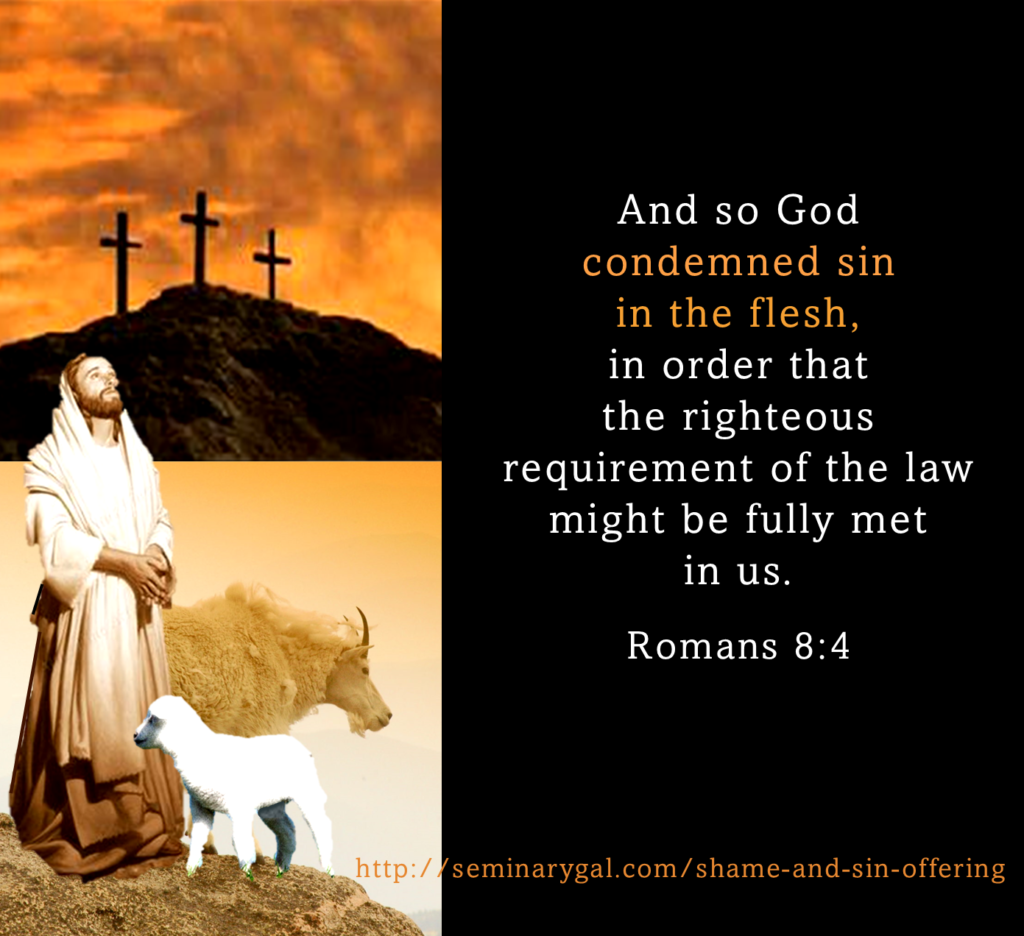
Read again “For what the law was powerless to do because it was weakened by the flesh, God did by sending His own Son in the likeness of sinful flesh to be a sin offering.  And so He condemned sin in the flesh, in order that the righteous requirement of the law might be fully met in us, who do not live according to the flesh but according to the Spirit.  Those who live according to the flesh have their minds set on what the flesh desires; but those who live in accordance with the Spirit have their minds set on what the Spirit desires. The mind governed by the flesh is death, but the mind governed by the Spirit is life and peace.  The mind governed by the flesh is hostile to God; it does not submit to God’s law, nor can it do so.  Those who are in the realm of the flesh cannot please God.  You, however, are not in the realm of the flesh but are in the realm of the Spirit, if indeed the Spirit of God lives in you. And if anyone does not have the Spirit of Christ, they do not belong to Christ.  But if Christ is in you, then even though your body is subject to death because of sin, the Spirit gives life because of righteousness.” (Romans 8:3-10)

Just how was God willing to give us the righteousness of Christ?  Stay tuned…

Continue Reading

Shame and Sin Offering

Now, whether you look at the Hebrew language or the Greek language of the Bible, the very same word for sin is, at times, also translated sin offering.  Doesn’t make sense, right? From a purely human perspective, sin cannot be a sin offering.  But from God’s viewpoint, all our iniquity (sin) was laid upon Jesus by the hand of God the Father…like the High Priest did with the scapegoat sent into the wilderness from ages past.  

But there are huge distinctions!  Yes, our sin carried to death by Jesus as an act of divine obedience, a sacrifice.  But because Jesus is God and the obedient Son, it was also a sin offering by Him…completely righteous, perfectly holy, and fully glorifying to the Father as the purest and most holy of sacrifices.

Let’s look again at Romans 8:3-4. “For what the law was powerless to do because it was weakened by the flesh, God did by sending His own Son in the likeness of sinful flesh to be a sin offering.  And so He condemned sin in the flesh, in order that the righteous requirement of the law might be fully met in us, who do not live according to the flesh but according to the Spirit.“

Also remember, Jesus was no whipping boy,
no mere ancient scapegoat sent off to die. 
There was far more to the Crucifixion than just punishment for Jesus
while retaining our own moral agency,
enabling us to start each year with a clean slate to sin all over again.

No, our sin was “imputed” to Christ…as the hymn “It Is Well” says, “not in part, but the whole”. From a divine perspective, all the iniquity/ sin that was ours (humanity’s whole) was instead offered to God and paid for—in full—by Jesus’ blood.  

Jesus, who identified with us through His Incarnation, Baptism, and now Crucifixion…was made to “be sin”, in the likeness of sinful man for the purpose of being the sin offering back to God on our behalf. 

How did this do anything different than the scapegoat? 
What does the Bible say? 

“And so He condemned sin in the flesh, in order that the righteous requirement of the law might be fully met in us, who do not live according to the flesh but according to the Spirit.” 

Here’s what’s amazing:  no goat or sheep—even ones sent or sacrificed—could ever fully meet our “righteous requirement” like Jesus did.  How did He do that? Stay tuned….

Continue Reading

Shame and Two Realms

As I continue to ponder whether Jesus experienced shame, there is no denying what the Apostle Paul was careful to describe: 

“God made Him who had no sin to be sin for us, so that in Him we might become the righteousness of God.” (2 Corinthians 5:21)

Jesus had no sin.  That’s the easy part. 
The hard part is to understand what it means that He would “be sin” for us. 
And further, how could He “be sin for us” without experiencing shame?

Any of you who have read more than a few posts I’ve written may recall that I’m fond of analogies.  Even though they all fall apart when pressed, there are things that become easier to understand when I think of them via analogy.  Today’s analogy is iridescence.

The same iridescent fabric is—in fact—one color viewed directly.  But when viewed from one angle the light is interrupted in a way that it appears a different color, say blue.  View it from another angle and it appears another color entirely, say gold.  Is the fabric gold?  Yes, in the moment.  Is the fabric blue?  Yes, to our view at the time.  But is the fabric in its existence changed or just our assessment from the position we view it?  Could it therefore, be iridescent white while simultaneously be gold and blue to two different people from their directional perspectives?  Hold that thought.

Jesus was fully man and fully God…all the time He walked on earth.  That’s a mystery difficult to wrap one’s mind around.  Unless we ponder that His spiritual being is unchanged.  That’s how God the Father sees Him.  Jesus is always God….and existed in heaven before all time and as He remains forever into the future.  Therefore, His eternal view was/ is/and reliably will be spiritual, divine, holy, and righteous.  After all, He’s God.

As He walked upon the earth, though, He was made flesh and His perspective (how He viewed the world) was self-veiled divinity.  Note, however this is not a division in His being which would be heresy.  Jesus was undivided.  His light was self-veiled … “interrupted” in a sense … so that He would see as a man would: through the clear lens of pure humanity, as Adam and Eve were at Creation.  It’s how He could truly feel temptations but not give in to them.  He could see sin coming a mile away, but never do the sinful thing.  He could experience the pain of knowing what death did to His precious creation, feel grief, and even anger at sin and death.  More though, He could feel death personally in His humanity.  Yet God did not die.  Hold that thought, too.

Romans 8 has much to illuminate this idea: “For what the law was powerless to do because it was weakened by the flesh, God did by sending His own Son in the likeness of sinful flesh to be a sin offering.  And so He condemned sin in the flesh, in order that the righteous requirement of the law might be fully met in us, who do not live according to the flesh but according to the Spirit.  Those who live according to the flesh have their minds set on what the flesh desires; but those who live in accordance with the Spirit have their minds set on what the Spirit desires. The mind governed by the flesh is death, but the mind governed by the Spirit is life and peace.  The mind governed by the flesh is hostile to God; it does not submit to God’s law, nor can it do so.  Those who are in the realm of the flesh cannot please God.  You, however, are not in the realm of the flesh but are in the realm of the Spirit, if indeed the Spirit of God lives in you. And if anyone does not have the Spirit of Christ, they do not belong to Christ.  But if Christ is in you, then even though your body is subject to death because of sin, the Spirit gives life because of righteousness.” (Romans 8:3-10)

Two realms.  Two perspectives.  Same person Jesus Christ who “endured the Cross, scorning its shame” (Hebrews 12:2) but even as His flesh experienced death, “Jesus called out with a loud voice, “Father, into your hands I commit My spirit.” When He had said this, He breathed His last.” (Luke 23:46)

He scorned the shame a crucifixion forced “on” His flesh. 
But His Spirit was untouched. 
He didn’t die as a superhuman,
but fully human with His mind governed by the Spirit in a fully human sense. 
His Spirit never died, though His body did. 
Same undivided Jesus. 
Two realms… the Spirit belongs with God,

but shame, sin, and death belong solely to the flesh. 

Yes, a lot of deep thought, but here’s where the rubber meets the road for us: if you’re “born again,” shame belongs to the old self, not the born again one as you are born of the Spirit.

Continue Reading

Shame and Moral Relativism

There will never be such a lasting and consequential failure
as that of Adam and Eve in Eden
when a single bite of fruit from the forbidden tree
plunged all humanity into guilt and shame.

Nothing we can do will be able to cover our guilt and relieve our shame because it all goes back to God and our separation from Him.  And it all began with Adam and Eve, the first to experience shame and fear of God in the negative sense.

Shame and fear—both are rooted in guilt
because it’s guilt when we sin and fail to obey God. 
Shame is our reaction when we fall short or remember times we did. 

But short of what?  That’s the key. 
It’s the dividing line between those of faith … and those of the world.

Cultural anthropologists parse shame as arising from transgressing mere cultural or social values.  When it’s visible to others and exposed for failure to meet the world’s performance standards, we experience shame.

They parse guilt as privately sourced and dwelling in one’s internal values.  In other words, to these cultural anthropologists, you feel shame only when others see your failures to perform or conform, and you feel guilt only when you violate your personal conscience which is linked to your own standards of right and wrong. 

When the standards are personal—everything I do is right, maybe everything you do is wrong, then I am justified in everything I do—and that leads to a really warped view.  If the murderer of the Jews in the Holocaust can feel justified in genocide, or the killer or live organ harvester of the Uyghurs in China has no conscience about it, where is the guilt? 

Wow, it’s a really warped view when one’s standards exist only internally.

This explains why moral relativism is so dangerous, destructive, and why the age we’re living in seems to be spiraling out of control.  When we have no anchor, no external reliable truth sometimes called moral absolutes, there is no real conscience about sin or guilt. 

Moral Relativism is at the heart of many of the world’s problems. 
When each person has his/her own version of the truth
and what constitutes right and wrong, then who holds the moral compass? 
It’s the old “Who are you to judge?” taken out of context.

There is only one Lawgiver and Judge, the one who is able to save and destroy. But you– who are you to judge your neighbor? James 4:12

There is One Judge, but culture denies Him.  We’ve turned away from the Author and Giver of the Moral Absolutes—our true compass for every human being.

Continue Reading

Good Intentions and Guilt

With Jesus there was no separation from God, no sin, and no guilt. 

Adam and Eve—at one point in their lives—were just like that! 
But then enters stage left, guilt on the coattails of sin. 

Together, Adam and Eve sinned and separation from God was the immediate outcome (as sin becomes guilt).  They weren’t separated from God because they made a mistake or because God was a control freak.  Back in that day, nothing was a mistake because everything God provided was perfect…including His command. 

Even God’s command was good and protective. 
Adam and Eve just didn’t believe it enough to obey it.

Adam and Eve’s own will and moral agency failed them in their eagerness to be like God.  It didn’t matter their motivation in seeing “the fruit of the tree was good for food and pleasing to the eye, and also desirable for gaining wisdom” or good intentions, perhaps, of wanting to be like the God who created and loves them. 

They didn’t believe God was fundamentally different from what they could become.

“For my thoughts are not your thoughts, neither are your ways my ways,” declares the LORD.  “As the heavens are higher than the earth, so are my ways higher than your ways and my thoughts than your thoughts. (Isaiah 55:8-9)

Fast forward to today when people make the mistake of believing good intentions and virtue signaling are enough. The world applauds and feeds the ego of the “good person”.  But God’s got perfect instructions for us in His Word (the Bible). 

Platitudes of “right-thought” abound, but as Martha’s Vineyard’s recent expulsion of 49 of the very people they claim to care about…the old “Not In My Back Yard”…in the end, these platitudes were exposed as fraudulent, a masquerade.  They’re not enough to save to eternity, earning it our way. 

Or like Adam and Eve thinking we can steer our own moral agency—even with good intentions and sincerity—all the while… violating what God says. 

Not one of those popular platitude signs says, “Obey God” or “Seek Jesus” or “We believe the Bible is Truth.”  Those are too risky, invite the FBI to raid your home, and don’t signal cultural virtue to the world’s onlookers and thought-police.

Just like back then, God’s Word is good and protective. 
We just don’t believe it the way we should.

Continue Reading

Shame and Glory

Continuing our discussion of shame and whether Jesus ever experienced it, maybe we need to look at shame through a more biblical definition and to contrast it with guilt.

Here’s our history: When Adam and Eve were in the Garden of Eden, walking with God, and enjoying His full presence in the cool of the day, they were naked and unashamed.  There was nothing to hide.  Nothing to be embarrassed about in the presence of the God who created them and loves them.

Adam and his wife were both naked, and they felt no shame. (Genesis 2:25)

But then that fateful, life-altering choice to do what God had expressly commanded them not to do.  Blame it on the serpent, but the moral agency for behavior resided individually within Adam and Eve. 

Genesis 3: 6 When the woman saw that the fruit of the tree was good for food and pleasing to the eye, and also desirable for gaining wisdom, she took some and ate it. She also gave some to her husband, who was with her, and he ate it.  7 Then the eyes of both of them were opened, and they realized they were naked; so they sewed fig leaves together and made coverings for themselves.  8 Then the man and his wife heard the sound of the LORD God as he was walking in the garden in the cool of the day, and they hid from the LORD God among the trees of the garden.  9 But the LORD God called to the man, “Where are you?” 10 He answered, “I heard you in the garden, and I was afraid because I was naked; so I hid.”  11 And he said, “Who told you that you were naked? Have you eaten from the tree that I commanded you not to eat from?”

Now all of a sudden, they know they’re naked, and they’re ashamed and afraid.  Ashamed in front of God (obviously since there was no one else there).  And they were afraid of Him.  Afraid of His knowing.  Afraid of His reaction.  Afraid of what He meant when He said, “you will certainly die”.  What did that even mean?  So, they were afraid.

What about Jesus?
He is (and was) as Adam and Eve were before their failure.

Was Adam fully human back then?  Yup.  So, if Jesus is fully human and is (and was) as the original Adam was when the first man was created… (and as aside, Jesus being the Creator would know) …

then shame and fear are not part of the original human condition. 

Jesus was never afraid … and arguably never felt shame. He could recognize both of those consequences of separation from God when He saw them in us. I say “arguably” because it’s a bit more complicated as to how He could be without experiencing shame and still experience all that broken humanity suffers. There was no shame before sin entered the picture. And Jesus had no sin. He had glory before the Incarnation and has glory now. It is during the parenthesis of His 30-year ministry during the Incarnation that He did not have the same glory He once did.

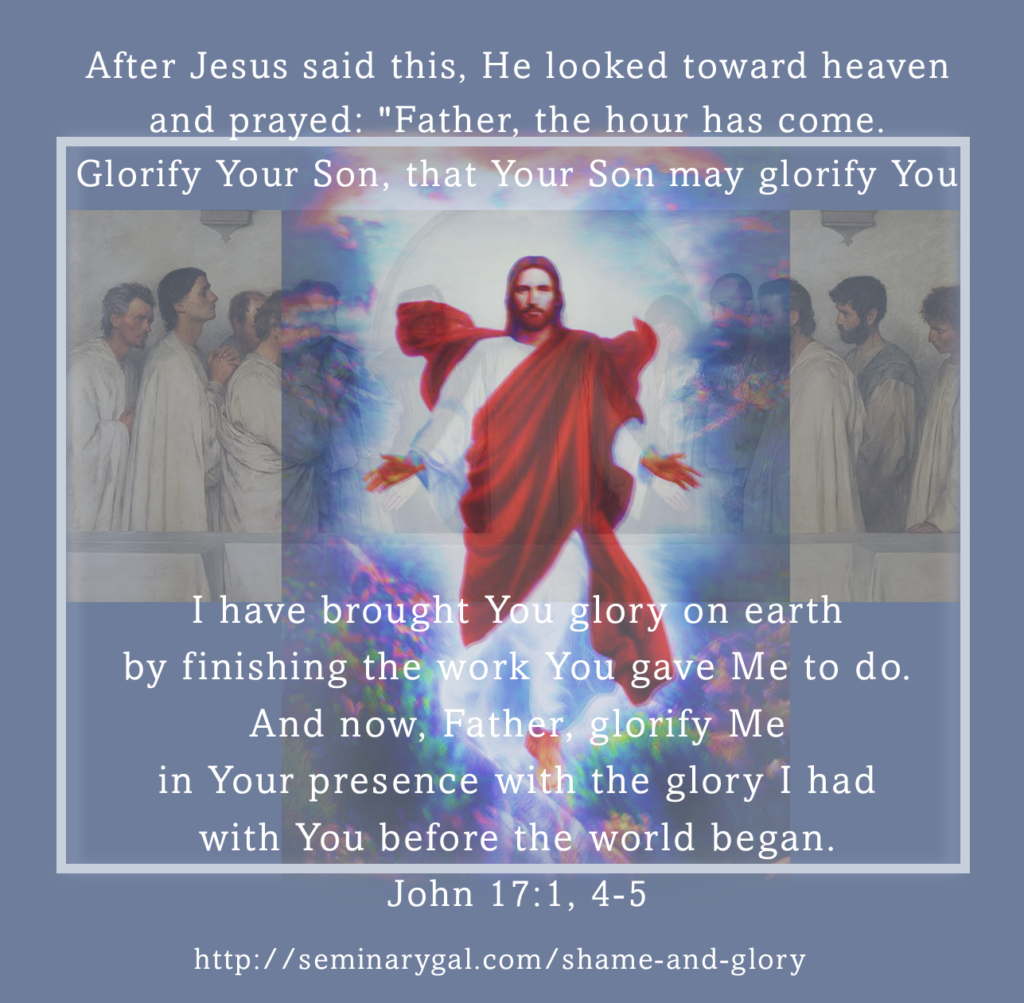
John 17:1 After Jesus said this, He looked toward heaven and prayed: “Father, the hour has come. Glorify Your Son, that Your Son may glorify You.  2 For You granted Him authority over all people that He might give eternal life to all those You have given Him.  3 Now this is eternal life: that they know You, the only true God, and Jesus Christ, whom You have sent.  4 I have brought You glory on earth by finishing the work You gave me to do.  5 And now, Father, glorify me in Your presence with the glory I had with You before the world began.

Read John 17.  Jesus finished God’s work…perfectly.  He honored the Father in all things.  From before the world began until the moment called “Today”, Jesus remains unashamed in the Father’s presence, and in His presence, there was and is no separation and never will there be.

Continue Reading

Shame and the Whipping Boy

What is Shame?

Shame has been defined as “a spiritual consequence of sin”Oxford defines shame as “the feelings of sadness, embarrassment, and guilt that you have when you know that something you have done is wrong or stupid.” None of them quite plumb the depths of the biblical definition.  Irrespective, it is always viewed as unpleasant, and the world’s definition often focuses on one’s self-perception and self-worth. 

Do you see the theological problem of Jesus’ having experienced shame as low self-worth or the consciousness of wrong or foolish behavior?

Less so, a spiritual consequence of sin because He could experience that consequence … of our sin, not His own … but then, is that really *experiencing* shame?  Or just receiving someone else’s punishment?

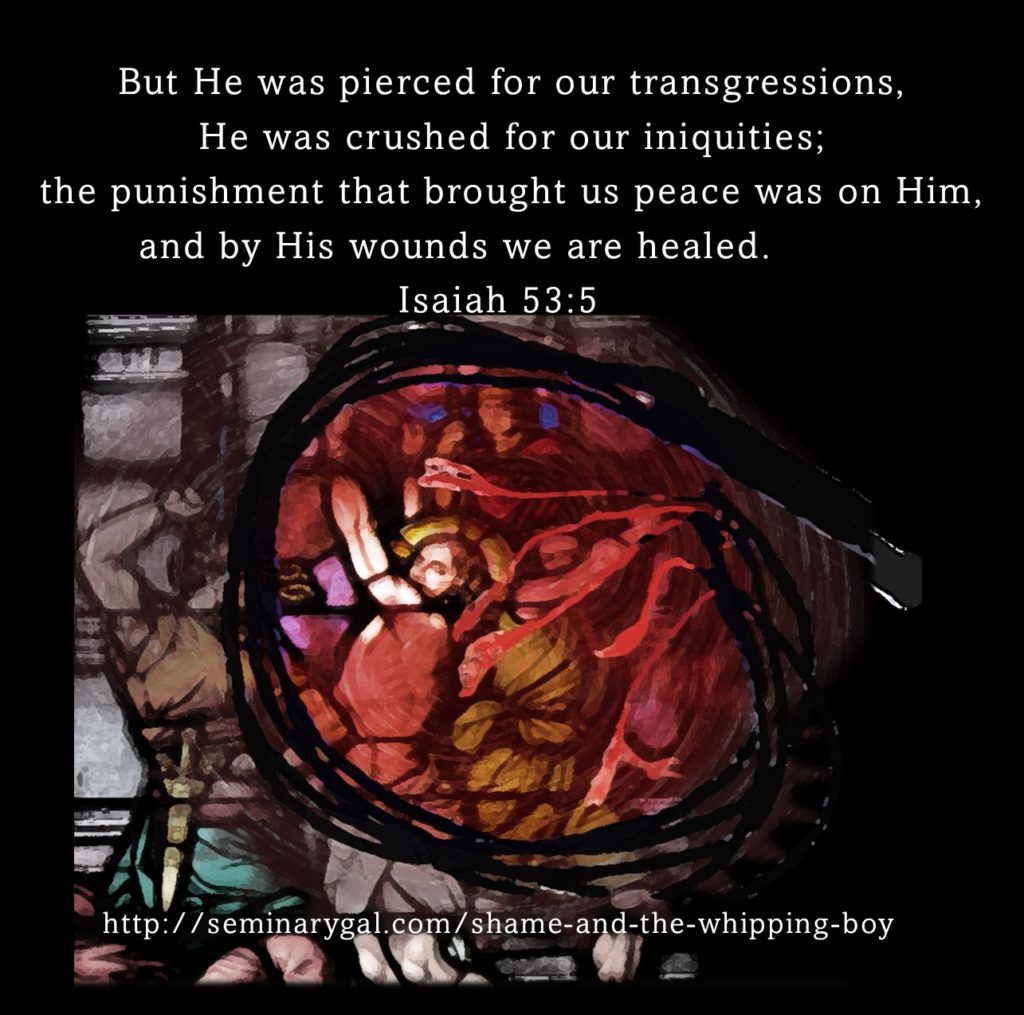
But He was pierced for our transgressions,
He was crushed for our iniquities;
the punishment that brought us peace was on Him,
and by His wounds we are healed.
(Isaiah 53:5)

You may have heard the strange phrase “whipping boy.”  Do you know where that comes from?

“It seems an odd notion to us now that a royal court would have kept a child for the purpose of beating him when the crown prince did wrong. That’s just what did happen though. Whipping Boy was an established position at the English court during the Tudor and Stuart monarchies of the 15th and 16th centuries.”    The saying ‘Whipping boy’ – meaning and origin. (phrases.org.uk) 

Did the crown prince receive the ability never to do wrong again by the whipping boy being whipped?  Would punishment still come to the whipping boy if the crown prince failed and did wrong again?  As any actual “moral agency” or intrinsic power over behavior resided within the crown prince, the whipping boy didn’t stand a chance of escaping another beating.

Now, let’s turn to what it means to experience something.

While the crown prince may have suffered the emotions of seeing someone whom he cared about being whipped, did the crown prince suffer in the same way (e.g., personally, individually, emotionally, or physically) as that of the “whipping boy” who felt every blow in his entire being?

Do you see where I’m headed?

We’ll get there but for now let’s just agree that Jesus was no mere whipping boy, punished instead of us.  Read Romans 3:20-26 (verses 20-22 below).

Romans 3:20 Therefore no one will be declared righteous in God’s sight by the works of the law; rather, through the law we become conscious of our sin.  21 But now apart from the law the righteousness of God has been made known, to which the Law and the Prophets testify.  22 This righteousness is given through faith in Jesus Christ to all who believe.

Continue Reading

Did Jesus Experience Shame?

Before dismissing the question, “Did Jesus Experience Shame?” with an offended “Of course not!”, one must ask if Jesus was truly human and to what degree is shame part of our human condition? 

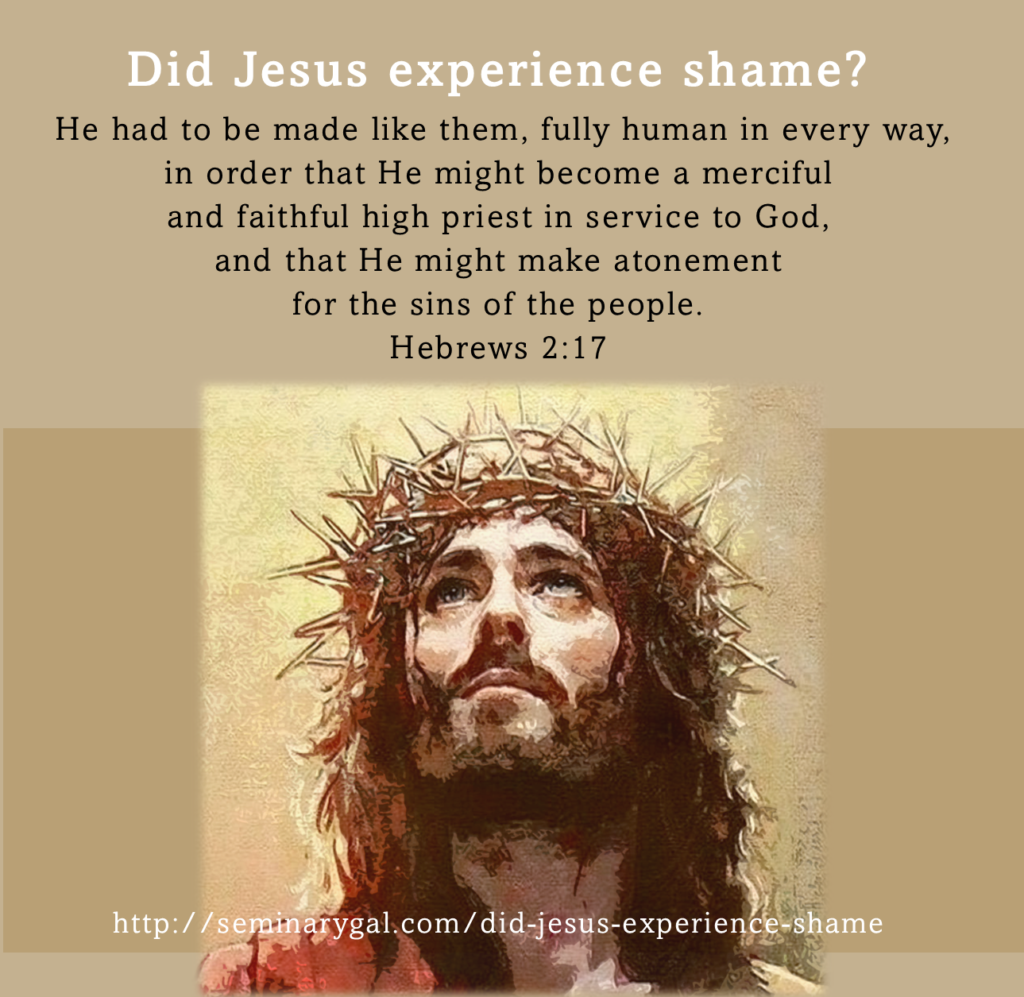
“He had to be made like them, fully human in every way, in order that He might become a merciful and faithful high priest in service to God, and that He might make atonement for the sins of the people. (Hebrews 2:17)

And if Jesus didn’t experience it, was He truly tempted in every way as we are (Hebrews 4:15)?  Was He made to be sin for us so that in Him we might become the righteousness of God (2 Cor. 5:21)?  Was Jesus a superhuman and not really like the rest of us?  But the mirror response of “Of course He did!” leaves open a quagmire of theological problems.

What is shame anyway? 

I’ve been quiet for a while, overwhelmed by life in general, trying to cling to my faith in the midst, toiling away with manual labor, being nourished by somewhat weak sermons that only left me hungry, and resorting to chewing on my own thoughts. 

This question, “Did Jesus Experience Shame?” has proven to be a rich for theological ideas to be mined.  There is an opportunity to go deep into shame–something we all experience to one degree or another– and a series is born in which we will explore whether Jesus, as fully-human-fully-divine, ever experienced shame.

Continue Reading

The Storm is Upon Us-Isaiah 26

The Storm is Upon Us

The wind whips us with forty lashes minus one.

The rain pelts in wave upon wave of needle pricks.

The air turns cold as the feeder bands come,

one after the other, in a relentless parade of persecution.

The storm is upon us, and there is no mistaking it.

Go to the inner room.

To the place of seclusion and safety.

Rest there in the stillness.

It is dark, windowless to the raging all around us.

The storm is upon us, and there is no mistaking it.

But God, You are our refuge.

You are the Master of the storm and the Stiller of the seas.

You silence the wind and shut the door to the storehouses of hail.

You govern the rain and the tides.

You set limits and seasons, and for that, Lord, we praise You.

The storm is upon us, but there is eternal safety for the righteous.

It’s a Passover of wrath in the quiet place of the heart.

In the heart secure in Christ.

His hand shields us as destruction befalls the wicked.

In Christ’s sanctuary of the soul,

We are at peace and rest,

And faith reigns unchallenged.

For our God is completely trustworthy.

The storm may be upon us, but there is eternal safety for the righteous.

As You say in Your Word,

“You will keep in perfect peace

    those whose minds are steadfast,

    because they trust in you.

Trust in the Lord forever,

    for the Lord, the Lord himself, is the Rock eternal.”

(Isaiah 26:3-4)
Amen and amen.

Continue Reading