Being Still When Spiritually Exhausted (Lent 31-2014)

SGL 31 2014 exhausted and want to die elijah

Exhaustion.  Have you ever experienced it? 

Many of us know what it’s like to be physically exhausted after doing strenuous activity for an extended period of time.  Our legs can feel like rubber and our arms may ache.  We may be out of breath and want to collapse in a chair or a bed and just sleep.

Spiritual exhaustion can happen easily to those of us exercising powerful faith on a regular basis.  It can even happen to those who are simply holding on, standing still, and facing the storm for a bit too long. 

Spiritual exhaustion ought not to be underestimated.  In many regards, it is more difficult to endure, can only be spiritually resolved, and can take longer to heal.

Elijah was spiritually exhausted.  Having faced the years of drought, then finally the rain, and his killing of Jezebel’s prophets, now Elijah had Jezebel on his heels trying to take his life.

Elijah was spiritually and emotionally spent.  He wished he was dead.

1 Kings 19:1 Now Ahab told Jezebel everything Elijah had done and how he had killed all the prophets with the sword. 2 So Jezebel sent a messenger to Elijah to say, “May the gods deal with me, be it ever so severely, if by this time tomorrow I do not make your life like that of one of them.” 3 Elijah was afraid and ran for his life. When he came to Beersheba in Judah, he left his servant there, 4 while he himself went a day’s journey into the desert. He came to a broom tree, sat down under it and prayed that he might die. “I have had enough, LORD,” he said. “Take my life; I am no better than my ancestors.”

There’s no shame in admitting that we feel this way from time to time.  Elijah, among the greatest of the OT prophets who was taken up into a whirlwind alive, wasn’t ashamed to admit to God, “I’ve had enough, LORD.”

Depression and exhaustion go hand in hand. 

Those of us who know spiritual exhaustion well also know that depression is the shadow that follows behind exhaustion. 

It isn’t a loud boisterous killer of the spirit, but it’s there—insidiously so.  It tags along, leeching off the life of the godly man or woman who is weakened by fighting the fight.  Depression is parasitic and it sucks the life and the joy and the peace out of a person.  Elijah felt that painfully.

What happened then?  God provided help in a variety of ways (1 Kings 19:5-21):

  1. Rest (1 Kings 19:5)
  2. Sustenance (1 Kings 19:5-6)
  3. Compassion in the form of acknowledging that the journey is hard (1 Kings 19:7)
  4. Strength to forge ahead (1 Kings 19:8)
  5. God’s reassuring presence (1 Kings 19:11-13)
  6. Information that God only knew–information that would encourage Elijah
    • Direction (1 Kings 19:15)
    • Succession plan (1 Kings 19:16-17)
    • Divine perspective (1 Kings 19:18)

Strengthened by God’s provision, Elijah was able to pass the baton to Elisha, whom God provided to be Elijah’s attendant and successor with the mantle of prophet (1 Kings 19:-21)

Be Still.  I know you are weary.  I AM here to help you.

Be Still.  I know that the human spirit can withstand only so much.  I will refresh you.

Be Still and Know that I AM God.  Matthew 11:29 “Take My yoke upon you, and learn from Me, for I am gentle and humble in heart; and you shall find rest for your souls.”

Be Still and Know that I AM God.  Remind yourself of who I AM.  Psalm 23:1 “A psalm of David. The LORD is my shepherd, I shall not be in want. 2 He makes me lie down in green pastures, he leads me beside quiet waters, 3 he restores my soul. He guides me in paths of righteousness for his name’s sake. 4 Even though I walk through the valley of the shadow of death, I will fear no evil, for you are with me; your rod and your staff, they comfort me. 5 You prepare a table before me in the presence of my enemies. You anoint my head with oil; my cup overflows. 6 Surely goodness and love will follow me all the days of my life, and I will dwell in the house of the LORD forever.”

Questions for reflection:

  1. How often have you thought it was a sign of weakness to admit that you’ve had enough?  Does it seem unchristian or like a lack of faith?
  2. Where do you turn when depression hits?
  3. In the stillness, remind yourself of who God is and then look for how He provides for you.
  4. Elijah reached his limit and wanted to die.  What did God do, give Elijah the death he wanted as relief or something better?  Read 2 Kings 2:11 As they were walking along and talking together, suddenly a chariot of fire and horses of fire appeared and separated the two of them, and Elijah went up to heaven in a whirlwind.


SG 32     Where are you?  I’m unpopular with an unpopular job.  Jeremiah.

SG 33     Where are you? Running for our lives.  Joseph, Mary, and Jesus.

SG 34     Where are you? Preparing the way and getting disillusioned.  John the Baptist

PALM SUNDAY  Where are you?  I’m celebrating the Messiah and getting my hopes up.

SG 35     Where are you?  I’m at the well and I’m an outcast among women.

SG 36     Where are you?  I’m in Your boat on a stormy sea.  The discples.

SG 37     Where are you? I’m on the hillside and I have nothing to share but my lunch.  Little boy.

SG 38     Where are you? I’m at the Last Supper and You’re washing my feet. Peter.

SG 39     Where are you?  I’m at the foot of the Cross and I don’t understand.  Mary.

SG 40     Where are you?  I’m hiding because I was a disciple of Jesus.

EASTER SUNDAY               Where are you?  I’m at the empty tomb.  Mary Magdalene.


Continue Reading

Still Humiliated (Lent 30-2014)

Do you ever feel alone in this world?  Like everything is stacked against you?  Elijah had just royally ticked off King Ahab and his wife—the evil Queen Jezebel—by predicting a drought that would last for years. 

SGL 30 2014Where are you Elijah fed by ravensGo hide, God says.


1 Kings 17:1 Now Elijah the Tishbite, from Tishbe in Gilead, said to Ahab, “As the LORD, the God of Israel, lives, whom I serve, there will be neither dew nor rain in the next few years except at my word.” 2 Then the word of the LORD came to Elijah: 3 “Leave here, turn eastward and hide in the Kerith Ravine, east of the Jordan. 4 You will drink from the brook, and I have ordered the ravens to feed you there.” 5 So he did what the LORD had told him. He went to the Kerith Ravine, east of the Jordan, and stayed there. 6 The ravens brought him bread and meat in the morning and bread and meat in the evening, and he drank from the brook. 7 Some time later the brook dried up because there had been no rain in the land.

How humiliating.  Running for cover.  Drinking from a brook that was about to dry up.  Being fed meat and bread by ravens. (Yikes! You didn’t know where they’d been or where they got the meat and bread from—ugh!) But God told them to feed you, so there you go.  Being fed by ravens.  Then God adds insult to injury from a human perspective:

1 Kings 17:8 Then the word of the LORD came to him: 9 “Go at once to Zarephath of Sidon and stay there. I have commanded a widow in that place to supply you with food.” 10 So he went to Zarephath. When he came to the town gate, a widow was there gathering sticks. He called to her and asked, “Would you bring me a little water in a jar so I may have a drink?” 11 As she was going to get it, he called, “And bring me, please, a piece of bread.” 12 “As surely as the LORD your God lives,” she replied, “I don’t have any bread– only a handful of flour in a jar and a little oil in a jug. I am gathering a few sticks to take home and make a meal for myself and my son, that we may eat it– and die.” 13 Elijah said to her, “Don’t be afraid. Go home and do as you have said. But first make a small cake of bread for me from what you have and bring it to me, and then make something for yourself and your son. 14 For this is what the LORD, the God of Israel, says: ‘The jar of flour will not be used up and the jug of oil will not run dry until the day the LORD gives rain on the land.'” 15 She went away and did as Elijah had told her. So there was food every day for Elijah and for the woman and her family. 16 For the jar of flour was not used up and the jug of oil did not run dry, in keeping with the word of the LORD spoken by Elijah.

Yes, God was faithful!  Yet, the way He did it must have felt like a huge humiliation.  Elijah, in all your manliness, you will be fed by a woman.  Not just any woman!  The low social class of a poor widow with no means of providing for herself and on the edge of starvation.  Not just any widow.  No!  This widow was from Zarephath.  The heart of pagan territory…a Gentile city of Sidon…and right under Jezebel’s nose.  However, God chose a widow who would show great faith.  She believed that Elijah was a man of God and she acted accordingly.  Therefore, God blessed all of them every day with food in keeping with God’s faithfulness and goodness.

Be Still.  When I call you to the brook and send you to time alone in the secret place, it’s because I AM prepared to provide for you there.  You need time to Be Still in order to be useful.

Be Still.  When I call you to exercise faith by obedience, even in humiliating things, I AM prepared to sustain you and to give life to you.

Be Still and Know that I AM God.  John 10:10 “The thief comes only to steal and kill and destroy; I have come that they may have life, and have it to the full.”

Be Still and Know that I AM God.  John 14:6 “I am the way and the truth and the life. No one comes to the Father except through me.”

Questions for reflection:

  1.  Read 1 Corinthians 1:27 “But God chose the foolish things of the world to shame the wise; God chose the weak things of the world to shame the strong.” Jezebel and Ahab were the so-called strong.  Who were the weak things in 1 Kings 17 whom God used to show that His wisdom is greater?
  2. There were probably all kinds of widows in Israel.  Consider that King Ahab was the Israelite king at the time.  His wife Jezebel, born a Phoenician princess, was queen over Israel.  Together they were political strong and worshipped false gods.  Therefore, what might be some reasons God chose to send Elijah to a widow outside the community of Israel?
  3. Jezebel has become an archetype of the evil woman.  Why is it helpful, therefore, that God chose to keep Elijah alive by the faith of a woman?
Continue Reading

When Leaders Fail Us

When Leaders Fail Us

For the second time in my life, I’ve been watching from the periphery as a pastor I admired has resigned over moral failings.  Having learned some lessons about how to handle things when leaders fail us, I thought it might be helpful to share these lessons with those who may be struggling to reconcile their feelings about leadership failures.

Let’s face it: leaders fail us all the time. 

It’s harder when the leaders are church leaders as compared to business or political leaders.  The reason it’s harder is that church leaders are supposed to stand for God, speak to us on His behalf, teach us what the Word says, and to model what godly living is all about.  Moral failings cut to the heart of each of those functions.

Fraud versus Flawed: When religious leaders fail us, we must distinguish between a leader being flawed and one who is a fraud.  Satan (and yes, I believe he’s real) relishes both the flawed and the fraud leaders who fail us.

A fraud is someone who is not and has not been a Christ-follower at all.  A wolf in sheep’s clothing.  A false teacher.  The frauds of this world fake it for the sake of personal gain and power.  (2 Peter 2:1 But there were also false prophets among the people, just as there will be false teachers among you. They will secretly introduce destructive heresies, even denying the sovereign Lord who bought them– bringing swift destruction on themselves. 2 Many will follow their shameful ways and will bring the way of truth into disrepute. 3 In their greed these teachers will exploit you with stories they have made up. Their condemnation has long been hanging over them, and their destruction has not been sleeping.)  Satan likes leaders who teach wrong things and cause us to believe lies about God.  The false teacher, the false prophet, and the leader who is a fraud can carry many people down a path of lies.

But when a leader fails us, it doesn’t mean that person has been a fraud. 
It means he or she has been flawed. 

All leaders are flawed in some manner or another.  We all sin and fall short of the glory of God (Romans 3:23).  Being flawed doesn’t make us frauds.  It makes us human.  That said, claiming humanity will not excuse what we have done, but it will illuminate the process going forward.  We cannot hit the rewind button on our lives and get a do-over, but we can hit stop or pause and make different decisions, ones that honor God for the future.

Satan likes flawed leaders because it’s the easiest way of stopping the forward progress of the church.  Target one, take down many.  The bigger the target, the greater the take-down.  If Satan can get us disillusioned with one another in the church, particularly leaders–because we’re all flawed–it can get us down the same path of lies.  It can convince us that Christians are nothing but a pack of liars, cheats, and hypocrites.  That is the lie Satan wants us to believe because the only thing Satan hates almost as much as he hates God is Jesus’ Church (because it belongs to God).   What flawed leaders ought to teach us is that God’s grace is greater than all our sin.

It is a trustworthy statement, deserving full acceptance, that Christ Jesus came into the world to save sinners, among whom I am foremost of all. (1 Timothy 1:15).

Consequences of Fraud and Flawed:  The consequence of being a fraud, refusing to repent, and denying God is ultimately destruction.  Being an unrepentant false teacher is a dangerous place to be.  The accountability one pays for preaching a different gospel than the one handed down to us is severe because the punishment is commensurate with the number of people led astray.  The bigger the ministry following, the greater the fall because the same number of people you could have blessed (if you had been telling the truth) is the same number you harm when you’re a fraud and lead others straight into sin.

Being simply flawed has consequences too.  King David was flawed, fell from grace, yet he repented and we are reminded that he was still called a man after God’s own heart (Acts 13:22).  This doesn’t mean that he didn’t experience consequences to his sins, however.

Genuine leaders must have authority, credibility, and authenticity. 

Falling from grace removes those three important characteristics and therefore the leader must relinquish the position of leadership.  God can restore authority and credibility and even authenticity over time.  But one cannot continue to lead effectively and for the sake of the Church, the leader must resign.  The Church must accept this and not try to reinstitute the fallen leader before God has fully restored those 3 functions of authority, credibility, and authenticity.  Many fallen leaders will never be restored to a ministry position.  Some parishioners, including quite a few seminary professors and theologians, believe a ministry leader who falls can never be restored to a place of leadership.

I remember the first time I was forced to confront my feelings on this as a parishioner.  I was sitting in the balcony of a mid-size church’s sanctuary.  You could have heard a pin drop in the silence of the moments before the pastor confessed openly.  I was in seminary at the time and the Holy Spirit made it very clear that the Christian’s response to this is prayer, forgiveness, grace, justice, and steadfastness.

That could just as easily be you,” the Holy Spirit admonished, as God caused me to think deeply about this topic.

You see, no one wakes up in the morning and decides willingly to fall from grace, but rather the decision typically takes the form of a million drops of water that fill the bucket and the accumulated weight eventually tips the scale.  One drop makes the difference between a bucket known only to you and God…and a spilled bucket suddenly being known to everyone else.  Both you and God have known since the first drop dripped.   In some cases, however, we are so self-preoccupied and self-deceived we are not even aware of the first drop until after it happens.  Sin is insidious in that way.

The responses of the parishioner facing a leader’s fall from grace should include prayer, forgiveness, grace, justice, and steadfastness.

Pray that God will protect the person who fell from grace and his/her family from hatred and condemnation.  Pray that God will preserve the family unit and comfort each of them as they grieve the consequences of sin.  Pray for their marriage if they were married.  Pray for their extended families (children, parents, siblings, etc.) since it can be humiliating to admit that your parents or children, brothers or sisters, fell into sin.  Pray that betrayal doesn’t turn to bitterness.  Pray for the leadership of the church that remains behind.  Pray that the leadership remnant will seek God’s direction to fill the void and be patient while God works His miracle of healing.  Pray that people will not abandon the faith on account of it.  Pray against the evil one (Satan) and any havoc he might want to gain.  Pray that no one among the parishioners will have a stumbling block to their faith.  Pray that the witness of the church will be holiness (not whitewashing the sin), truth (admitting the failings and the process for dealing with them), and restorative (since even sin we regret cannot separate a man or woman from the love of God).  Pray that unbelievers can see the unconditional love and unmerited favor of God in the church as people talk and respond, and that God can redeem even this to His glory. Pray that the sheep will not be scattered.  Pray that God will bring glory to Himself in each person’s reaction.

Forgiveness is another response parishioners must have.  Forgiveness is not saying the sin did not happen or that it did not matter, but admitting the sin in all its destructiveness and then demonstrating the kind of forgiveness that God has shown to us.  Colossians 3:13 “Bear with each other and forgive whatever grievances you may have against one another. Forgive as the Lord forgave you.”  Matthew 6:14 “For if you forgive men when they sin against you, your heavenly Father will also forgive you. 15 But if you do not forgive men their sins, your Father will not forgive your sins.”  Forgiveness will be among the greatest witnesses to the unbelieving population in the midst of this tragedy.  It will show that Christians aren’t perfect and that Christians aren’t sinless, but that Christians stand powerfully in the complete forgiveness of Christ, washed clean by His blood.

Grace is another response that parishioners will be wise to demonstrate.  It goes beyond forgiveness and adds blessing.  Grace is what God has shown to us and it is what we must show toward the sinner.  It likewise is a great witness.  How can the Christian show grace in these times?  Christians can send cards of encouragement to the sinner and let him/her know that prayers of support are ongoing.  Christians can provide meals or financial assistance to the family if there is hardship now that the leader’s employment is gone as a direct result of sin.  Parishioners can give emotional support and friendship if jail time is involved (both visiting in prison and being a friend to the family members).  Grace is also evident when those in the leadership remnant look out for the welfare of the weakest of the faith.  Grace gathers the scattered sheep and binds their wounds.  It is being very sensitive to how events like this can further wound the already wounded.  Ezekiel 34:16 I will search for the lost and bring back the strays. I will bind up the injured and strengthen the weak.

Justice.  Grace and justice go hand in hand, however.  God will accomplish justice.  Grace does not stand in the way of genuine justice.  Ezekiel 34:16 “I will search for the lost and bring back the strays. I will bind up the injured and strengthen the weak, but the sleek and the strong I will destroy. I will shepherd the flock with justice.”  Justice says that punishments outlined by law are followed.  Restitution to those harmed must be paid.  Damage to other people must be resolved.  Grace triumphs.  Justice is done.  In part, this is why leaders must resign and why parishioners must accept it–even if the leader was popular and beloved.  Difficult as the days ahead may be without that leader, it is justice that demands that we orient ourselves toward holiness.  The remnant of leadership will need your loving-kindness, encouragement, support, and above all, your prayers in order to stand firm and resolute toward God’s holiness.

Steadfastness.  A fifth response that parishioners can have is steadfastness.  Be on the lookout for those who are disillusioned and being scattered.  Befriend them and bring them back in.  It is a way of thwarting Satan’s purposes in all this evil.  Support those in the remnant leadership by not abandoning the church in search of another “better” church.  All churches have sinners.  Apart from Jesus Christ, the true Head of the Church, all church leaders are sinners.  There are many reasons to leave a church (e.g. moving out of the area, unfaithful teachings or unfaithful use of the body of Christ, God’s calling you to a place of employing your gifts for His glory, etc.).  Leaving a church because of one leader’s moral failings must be very carefully considered because it communicates things about your spiritual life.  It points to whether you were at the church because of Jesus or because of the leader.  It points to who you were worshiping.  It points to putting leaders on pedestals as if leaders are superior or demi-gods.  It also reflects your understanding of judgment, grace, and forgiveness.  Other people will watch your decision and—whether in or outside of the church—your steadfastness or lack of it will say much about your view of Jesus and His Church.  Leaving a church is a theologically powerful statement about you.  Leaving the church period is a victory for Satan.

If you’re currently grieving a leader’s fall from grace, it’s helpful to know that a fall like this doesn’t happen in isolation.  Everyone will feel the effects of it and will wrestle through it.  The insult that hits one part of the body of Christ affects it all.  1 Corinthians 12:26 If one part suffers, every part suffers with it; if one part is honored, every part rejoices with it.

At times like this, the Good Shepherd will shepherd His flock and ensure that Satan doesn’t get the last word.  The leadership remnant left behind will be in good hands.  God will not forsake His Church.  Be sure to take time to gather the scattered.  Pray and remain faithful.  In time, God will restore the community and healing will occur.  We can assist the healing process by our actions during these difficult times.  Historically the Church grows the most when it is under assault.  Therefore, let’s do our best to ensure that God will be glorified in our choices and may His presence be seen in our actions.

Fallen leaders must confess, repent, and resign.  A time for restoration and repentance will be part of the healing they will need as they seek reconciliation with God and with a family who feels betrayed.

Parishioners are wise to love one another by praying, offering forgiveness, showing grace, accepting justice, and promoting steadfastness.  This is a good way forward when leaders fail us.

Human leaders will fail us from time to time, but God is bigger than any of our failings.  His forgiveness is bigger, His grace is wider, and His love is deeper than problems of moral failings, even in the church.  Furthermore, the Church is His.  We belong to Him and He will purify us and make us into a presentable Bride for the King of Glory.  Inwardly we groan and that great day of salvation may seem to be slow in coming from our standpoint, but God is the leader we can always trust…even when human leaders fail us.
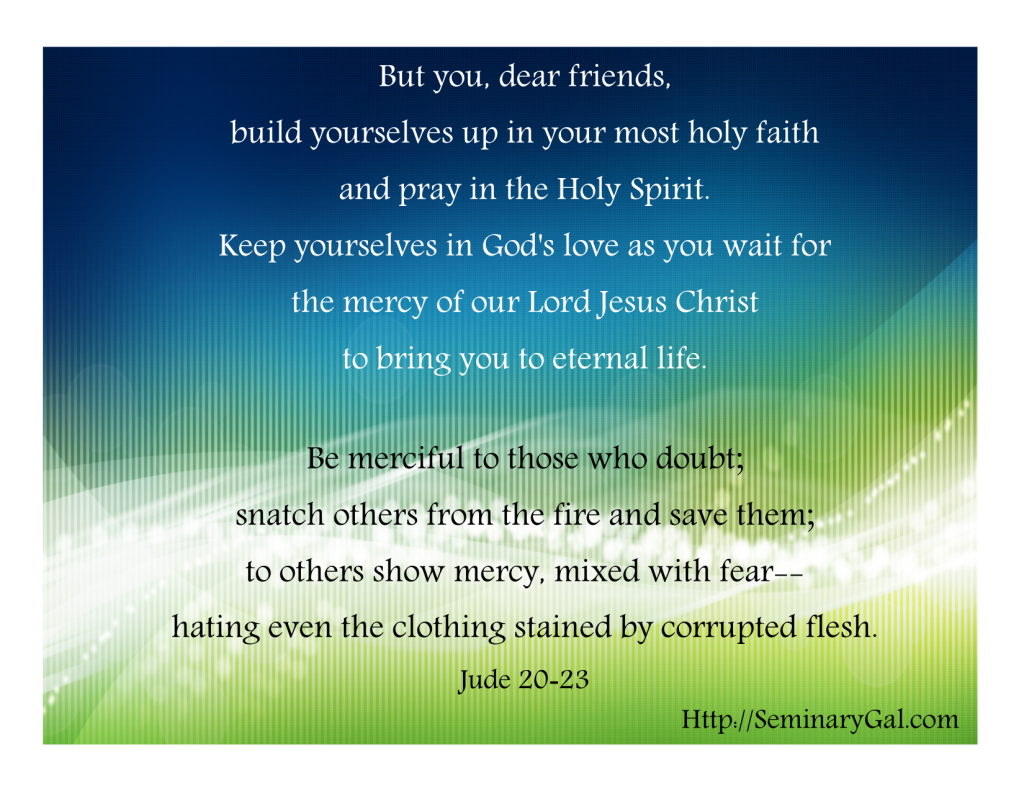

Jude 1 20to25

Continue Reading

Still Doing What You Told Me Not to Do (Lent 29-2014)

In the musical My Fair Lady, there is humorous misogyny on full display.  Or at least a chauvinistic spirit as comic relief.  Nowhere is it more visible than in two songs sung by the linguistics professor Henry Higgins:  “Never Let a Woman in Your Life” and “Why Can’t a Woman be More Like a Man?”

SGL 29 2014Where are you Solomon what you told me not to doYou can see what I mean at this video:  Click here to view.

King Solomon’s problem was not that he hated women. 

Nope.  He loved women and lots of them.  It’s not that he thought so little of women, but rather that he thought too much of them, way too often, and about way too many of them.

God told him not to do it. 
But he did it anyway.

The wisest man in the world, blessed by God, King Solomon had much wisdom…but at times, little common sense or willing obedience. 

God even warned him about it, but King Solomon ignored all of God’s warnings and look what happened: the wisest man in the world squandered it all and became the biggest fool of all history.

NIV 1 Kings 11:1 King Solomon, however, loved many foreign women besides Pharaoh’s daughter– Moabites, Ammonites, Edomites, Sidonians and Hittites. 2 They were from nations about which the LORD had told the Israelites, “You must not intermarry with them, because they will surely turn your hearts after their gods.” Nevertheless, Solomon held fast to them in love. 3 He had seven hundred wives of royal birth and three hundred concubines, and his wives led him astray. 4 As Solomon grew old, his wives turned his heart after other gods, and his heart was not fully devoted to the LORD his God, as the heart of David his father had been. 5 He followed Ashtoreth the goddess of the Sidonians, and Molech the detestable god of the Ammonites. 6 So Solomon did evil in the eyes of the LORD; he did not follow the LORD completely, as David his father had done. 7 On a hill east of Jerusalem, Solomon built a high place for Chemosh the detestable god of Moab, and for Molech the detestable god of the Ammonites. 8 He did the same for all his foreign wives, who burned incense and offered sacrifices to their gods. 9 The LORD became angry with Solomon because his heart had turned away from the LORD, the God of Israel, who had appeared to him twice. 10 Although he had forbidden Solomon to follow other gods, Solomon did not keep the LORD’s command. 11 So the LORD said to Solomon, “Since this is your attitude and you have not kept my covenant and my decrees, which I commanded you, I will most certainly tear the kingdom away from you and give it to one of your subordinates. 12 Nevertheless, for the sake of David your father, I will not do it during your lifetime. I will tear it out of the hand of your son. 13 Yet I will not tear the whole kingdom from him, but will give him one tribe for the sake of David my servant and for the sake of Jerusalem, which I have chosen.”

Are there any areas of your life where you are slapping God’s face by your willing rebellion?  Galatians 6:7 Do not be deceived: God cannot be mocked. A man reaps what he sows.

Reaping what you’ve sown can be a pleasant harvest or a grim reaping.  The choice on this one is yours.  Will you have a pleasant harvest of God’s bounty in your life?  Or will you have a rather grim reaping of the consequences of rebellion against God?

Be Still.  I want for you to know bounty and joy.  But that only comes with your being holy.

Be Still.  There’s grace for when you fail and you repent.  There are only consequences if you fail to repent.

Be Still and Know that I AM God.  I will not and cannot be mocked.  I will guard My holiness against any assault from you.

Be Still and Know that I AM God.  Isaiah 42:8 “I am the LORD; that is my name! I will not give my glory to another or my praise to idols.”

Questions for reflection:

  1.  Are there any gods in your life to which you are trying to give equal billing alongside God?  Money?  Career?  Family?  Sports?
  2. Perhaps you think you have no other gods.  Are there things you spend much time thinking about?  More than you think about how God views matters?
  3. If you have any other allegiances, ask God to help you put them in their proper perspective.  Ask Him to order your allegiances—not so that you care less about important things, but so you’ll care more about the most important concern: God’s rule over your life.


Continue Reading

Shoulda Been Still (Lent 28-2014)

King David was where he shouldn’t have been.  He was on the prowl when he shoulda been still.  He should have been with his troops out on the battlefield encouraging them to remain strong and faithful.  Instead he was on the rooftop and a war was raging inside him (2 Samuel 11).

Remaining strong and faithful wasn’t on his mind.

Bathsheba was.

Had he been doing what he should have been doing and been where he should have been, he could have avoided a whole lot of problems.

Have you ever found yourself in a similar situation?  You end up in the wrong place at the wrong time to do the wrong things with the wrong people and it leads directly to sin.  And then sin leads to more problems and the more you try to cover it up, the worse it gets?

Sin will always take you farther than you want to go, make you stay longer than you want to stay, and cost you more than you’d ever want to pay.  David learned this lesson the hard way.

SGL 28 2014Where are you Should Not have beenHow did he ever get himself in this situation?  Well, one thing is for sure: he didn’t inquire of the LORD on this one.

Life doesn’t give us automatic do-overs.  We make mistakes, sin, fall short, do horrible things that we regret and we simply cannot rewind to the place where we headed down the wrong path and do what is right instead.  Yes, there is grace for the times we fail, but there are also consequences.

How can you avoid being in the wrong place at the wrong time doing the wrong things with the wrong people and end up in sin?  Be Still and inquire of the LORD.  That’s a really good start.  If you follow the LORD at every step of the way you won’t find yourself on the path of regret.

Do not forsake wisdom, and she will protect you; love her, and she will watch over you.  (Proverbs 4:6)

There’s an analogy I like to use.  Imagine a westbound train.  You are standing on the platform and have a choice to board the train or stay on the platform.  Once you’re on the train going westbound, you can run eastbound on board the train as fast as you want and you’re still going to end up where the train is headed.  Stay off the train if you don’t want to arrive at its destination.

Be Still.  You can avoid the shoulda-woulda-couldas of life.

Be Still.  I will never steer you wrong.  I will never lead you to sin.  I will guide you clear of it, if you’ll let Me.

Be Still and Know that I AM God.  If you live according to My ways, you’ll never have regrets.

Be Still and Know that I AM God.  The destination of heaven is worth it.  Trust Me.  I live here.

Questions for reflection:

  1. What train platform are you standing on?  What train is boarding now and have you considered its destination?
  2. What is the best way to live with no regrets?
  3. Name a few decisions you’ve made that could not be undone.  How many of them are regrets either in timing or in having made that decision at all?
  4. Read James 1:13 “When tempted, no one should say, “God is tempting me.” For God cannot be tempted by evil, nor does he tempt anyone; 14 but each one is tempted when, by his own evil desire, he is dragged away and enticed. 15 Then, after desire has conceived, it gives birth to sin; and sin, when it is full-grown, gives birth to death.”  Progressing from thought to word to action, where is the best place for stopping sin?
Continue Reading

Still Waiting (Lent 27-2014)

Perhaps 15 years separated David’s being privately anointed as king by the prophet Samuel and the time he was publicly anointed and actually proclaimed king following Saul’s death.  King David demonstrated great patience while waiting upon God’s promises.  He even spared Saul’s life on several occasions.

How many of us knowing that destiny awaits could feel as though we were entitled to what God has promised?

There’s a heart attitude here in David’s life of humility and confidence in God.  The same confidence he showed facing Goliath when he taught the Israelites and the Philistines that placing one’s trust in human devices and efforts will be proved insufficient.  Only trust in God will do.  He said to the Philistine,

All those gathered here will know that it is not by sword or spear that the LORD saves; for the battle is the LORD’s, and he will give all of you into our hands.” (1 Samuel 17:47)

SGL 27 2014Where are you David in waitingI look at David—a complicated man of deep flaws, profound faith, beautiful artistry, and genuine passion—and find one of the most remarkable things about him during this time of his life remains his patience. 

The Philistine is dead and time goes on.

Saul remains king.

Time goes on and Saul is jealous of David and tries to have him killed. 

Retribution isn’t even in the equation.

For David, it was about waiting on the LORD.  Being still even while being a fugitive whose life is on the line.

When David hears that Saul is dead, does he rush into what’s rightfully his?  Does he grab the crown and the band from the Amalekite who brought them to him? ( 2 Samuel 1:5-12).  No.  David inquired of the LORD first.

2 Samuel 2:1 In the course of time, David inquired of the LORD. “Shall I go up to one of the towns of Judah?” he asked. The LORD said, “Go up.” David asked, “Where shall I go?” “To Hebron,” the LORD answered. 2 So David went up there with his two wives, Ahinoam of Jezreel and Abigail, the widow of Nabal of Carmel. 3 David also took the men who were with him, each with his family, and they settled in Hebron and its towns. 4 Then the men of Judah came to Hebron and there they anointed David king over the house of Judah.

David was 30 years old when he became king and he reigned forty years in all.  Half of his life had been spent waiting for his moment to ascend to the throne.  Could you wait 15 years after hearing what God is going to do before seeing it come to fulfillment?  Or would you get a bit impatient?  Would you seek instant gratification as soon as you see the finish line?

David didn’t.  He inquired of the LORD and God blessed David as he reigned over Judah for seven and a half years (2 Sam 5:5).  Eventually he would reign over both Judah and Israel.  He would move the capital city to Jerusalem and he would reign over all Israel and Judah for a total of 33 years.  David was a man after God’s own heart (Acts 13:22).  And that didn’t happen overnight.  It happened by Being Still for the long haul.  Still Waiting and constantly seeking the LORD’s presence.

Be Still.  Seeking Me will keep your heart pure.

Be Still.  Waiting upon Me is never wasted time.

Be Still and Know that I AM God.  In the fullness of time, I bring each thing to pass in accordance with My will.

Be Still and Know that I AM God.  Remember what I told you: Matthew 6:33 “But seek first His kingdom and His righteousness; and all these things shall be added to you.”

Questions for reflection:

  1. How good are you at waiting on God?
  2. How might worship be an antidote for impatience?
  3. What does impatience say about who is on the throne of your life?


Continue Reading

Still Standing Against the Crowd (Lent 26-2014)

For any of us who have ever been called to stand against the crowd, we know what a frightening and uncomfortable place that can be.

SGL 26 2014Where are you Samuel against the crowdIt can be humiliating, being a name in the newspaper that people identify with fanatic, zealot, or kook.  It can be embarrassing, having people ostracize you and your family and slink away from you or hide behind shelves at the grocery store so they aren’t seen associating with you.


It can be heartbreaking, knowing that people are talking about you behind your back and in front of people who formerly would have called you “friend”…

…that is, before you became such a controversial figure.

But now you’re too dangerous.

Your very presence might cause some really good Holy Spirit agitation or conscience poking.  You don’t even have to say anything.  The Holy Spirit doesn’t always need you to speak…only to BE.  You enter a room and everyone’s already got an opinion even if you haven’t said a word.

I’ve been there.  Those statements are not a figment of an overactive or paranoid imagination.  That has been part of my life.  So I have great sympathy for those with a more prophetic call in serving God.  Oh, we are not prophets in the OT sense or even in the NT sense of John the Baptist, but there remains a gift of the Spirit and a call for some of us to stand against the crowd and to speak the uncomfortable Word.

Still standing against the crowd.  Speaking the uncomfortable Word.  Being a light–a vastly imperfect one–whom God places in the darkness of a world going to hell in a hand-basket.  To reach out and try to persuade some!  To preach the hard truth…in love…to people who oftentimes would rather not hear it.  To exhibit—by our very existence—the evidence to the contrary of traditions and beliefs commonplace in theological circles and to receive criticism by the status quo.  No one chooses this or willingly selects this role.  We’re compelled and so we do it.  We don’t have many friends.  It’s hard to love people like us.

Samuel—the bridge between the judges, prophets, and priests—had a tough row to hoe.   He was at first a priest working under Eli.  It was while he was ministering before the LORD that he received his call to be a prophet.  Prophets aren’t winners of popularity contests.

In 1 Samuel 8, we see that being a judge or a prophet is not hereditary.  The people…the crowd…came to Samuel, told him that his sons were no good, and demanded a king.

1 Samuel 8:6 But when they said, “Give us a king to lead us,” this displeased Samuel; so he prayed to the LORD. 7 And the LORD told him: “Listen to all that the people are saying to you; it is not you they have rejected, but they have rejected me as their king.”

God knew what He was dealing with.  He even told them what a king would do so the crowd would not be acting in ignorance (1 Samuel 8:8- 17).

1 Samuel 8:18 “When that day comes, you will cry out for relief from the king you have chosen, and the LORD will not answer you in that day.” 19 But the people refused to listen to Samuel. “No!” they said. “We want a king over us. 20 Then we will be like all the other nations, with a king to lead us and to go out before us and fight our battles.” 21 When Samuel heard all that the people said, he repeated it before the LORD. 22 The LORD answered, “Listen to them and give them a king.”

People can be really stubborn. 

People can act in really stupid ways and be led to believe really harmful things. 

People can be unequivocally brazen in their unbelief and rebellion against God.

Be Still.  It’s not a reflection on you, preacher.

Be Still.  I know where your heart is and I know where their hearts are.

Be Still.  I know it’s not easy being unpopular.

Be Still and Know that I AM God.  Matthew 5:12 “Rejoice and be glad, because great is your reward in heaven, for in the same way they persecuted the prophets who were before you.”

Be Still and Know that I AM God.  John 15:20 “Remember the words I spoke to you: ‘No servant is greater than his master.’ If they persecuted me, they will persecute you also. If they obeyed my teaching, they will obey yours also. 21 They will treat you this way because of my name, for they do not know the One who sent me.”

Questions for reflection:

  1. How do you react to people when it becomes clear they have a calling that makes you uncomfortable or doesn’t jibe with your pre-understanding?
  2. Is there a distinction between people who take on the role of intentionally being uncomfortable to be around (e.g. unloving, unpleasant, finger-pointing people who pass judgment right-and-left) versus those whose words from the Bible arouse a discomfort or a sense of conviction?  How would you describe Jesus’ role?
  3. How can you tell the difference between self-appointed Bible thumpers and those God has gifted for speaking hard truths?
  4. If you are equally beloved by the world and by the church how might that be good?  How might it not be good?
Continue Reading

Stillness Before God When People Are Judging You (Lent 25-2014)

SGL 25 Where are you Hannah in the temple cryingHannah was brokenhearted.  She faced the exultations of her husband’s other wife again and again over Hannah’s infertility and this other wife’s bearing of many sons and daughters.  Hannah wept.  She couldn’t help it.  The love of her husband was profound, but her own failings as a wife—to give him children—loomed great in her eyes. 

1 Samuel 1:8 Elkanah her husband would say to her, “Hannah, why are you weeping? Why don’t you eat? Why are you downhearted? Don’t I mean more to you than ten sons?”

It was true, but to the grieving Hannah, it was insufficient consolation for all the judgment, inferiority, and barrenness she faced.

Have you ever been judged?

Hannah knew it all too well.  She was grieving, came to God in her grief and what did she get?  More grief—from the priest!

1 Samuel 1:12 As she kept on praying to the LORD, Eli observed her mouth. 13 Hannah was praying in her heart, and her lips were moving but her voice was not heard. Eli thought she was drunk 14 and said to her, “How long will you keep on getting drunk? Get rid of your wine.” 15 “Not so, my lord,” Hannah replied, “I am a woman who is deeply troubled. I have not been drinking wine or beer; I was pouring out my soul to the LORD. 16 Do not take your servant for a wicked woman; I have been praying here out of my great anguish and grief.”

I am not going out on a limb here by suggesting that religious people can be among the most judgmental ones.  In ways both subtle and overt, religious people can place themselves as judges over their neighbors, friends, and families. 

And it’s wrong.

Be Still.  I see your heart and know your grief.

Be Still.  I know what it feels like to be judged by others.

Be Still and Know that I AM God.  I’m the only real Judge out there.  Everyone else will eventually be called to account by Me.

Be Still and Know that I AM God.  This is what I think of judging:  Romans 14:10 You, then, why do you judge your brother? Or why do you look down on your brother? For we will all stand before God’s judgment seat. 11 It is written: “‘As surely as I live,’ says the Lord, ‘every knee will bow before me; every tongue will confess to God.'” 12 So then, each of us will give an account of himself to God. 13 Therefore let us stop passing judgment on one another. Instead, make up your mind not to put any stumbling block or obstacle in your brother’s way.”

Questions for Reflection:

  1.  When others judge you, does is say more about them or you?  Why do you think that?
  2. Hannah, in today’s Scriptures, brought her grief to the LORD.  1 Samuel 1:17 Eli answered, “Go in peace, and may the God of Israel grant you what you have asked of him.” 18 She said, “May your servant find favor in your eyes.” Then she went her way and ate something, and her face was no longer downcast.”  Hannah’s womb was opened and she gave birth to Samuel whom she devoted to the LORD.  How did worship of the LORD and prayer to Him in the face of judgment turn into blessing?
  3. What is the best approach to take when others are passing judgment on you?  What did Hannah do?


Continue Reading

Stillness When Moving Ahead (Lent 24-2014)

SGL 24 2014 Where are you Joshua Rahab Spies

Moses was a hard act to follow and Joshua, having been Moses’ right hand man all these years, knew that better than most.  It’s no wonder that he might have experienced a bit of trepidation about the whole lead-the-Israelites-into-the-conquest-of-the-Promised-Land thing.

God gives him the bad news…

…and then He gives him the good news.

Joshua 1:1 After the death of Moses the servant of the LORD, the LORD said to Joshua son of Nun, Moses’ aide: 2 “Moses my servant is dead. Now then, you and all these people, get ready to cross the Jordan River into the land I am about to give to them– to the Israelites. 3 I will give you every place where you set your foot, as I promised Moses. 4 Your territory will extend from the desert to Lebanon, and from the great river, the Euphrates– all the Hittite country– to the Great Sea on the west.

The bad news is that Moses is dead. 

The good news is that the LORD was going to have Joshua lead the people in the succession plan. 

Or was that bad news, too?

The Israelites weren’t known for being easy to lead.  Joshua had already seen that up close and personal.  But the good news was that as the LORD was with Moses, He was prepared to be with Joshua.

Joshua 1:5 No one will be able to stand up against you all the days of your life. As I was with Moses, so I will be with you; I will never leave you nor forsake you. 6 “Be strong and courageous, because you will lead these people to inherit the land I swore to their forefathers to give them.”

There’s just this little bit of advice:

 Be strong and very courageous. Be careful to obey all the law my servant Moses gave you; do not turn from it to the right or to the left, that you may be successful wherever you go.” (Joshua 1:7)

Obedience is the key to being still.

Be Still.  I AM prepared to lead you all the way.

Be Still.  I AM not going to leave you.  I AM not going to forsake you.

Be Still and Know that I AM God.  I AM going to fulfill all that I have sworn and promised.  I AM the very essence of faithfulness.

Be Still and Know that I AM God.  Remain faithful to Me and you will have strength and courage for anything I call you to do.

Questions for reflection:

  1. How are you doing in the obedience-to-God’s-ways category?
  2. What steps could you take today to become more obedient?
  3. Why do you think people resist being obedient to God?
  4. Read Joshua 2.  How did Rahab show obedience to the LORD, confessing His greatness, even though she was a prostitute? What does that say about human imperfection and what matters to God?


Continue Reading

Stillness and Wandering (Lent 23-2014)

SGL 23 2014Where are you Moses wanderingMen have a somewhat notorious reputation for not liking to ask for directions.  Deserved or not, I suppose, depends on the man. 

This man, Moses, wasn’t afraid to ask God for direction. So, the forty years of wandering about the wilderness weren’t Moses’ fault.  Moses was going exactly where God was leading the Israelites.  

Maybe aimless geographically, but with a very clear and direct purpose. 

Thousands of rebellious Hebrews were wandering all around the Sinai Peninsula killing time, or being killed by time.  This was the end for any of the ingrates who could only think of their stomachs and their safety even after God brought them out of Egyptian slavery… on dry land… miraculously…through the Red Sea and refused to enter the Promised Land because of unbelief in God.

How easily they and we forget!

Hebrews 3:1 Therefore, holy brothers, who share in the heavenly calling, fix your thoughts on Jesus, the apostle and high priest whom we confess. 2 He was faithful to the one who appointed him, just as Moses was faithful in all God’s house. 3 Jesus has been found worthy of greater honor than Moses, just as the builder of a house has greater honor than the house itself. 4 For every house is built by someone, but God is the builder of everything. 5 Moses was faithful as a servant in all God’s house, testifying to what would be said in the future. 6 But Christ is faithful as a son over God’s house. And we are his house, if we hold on to our courage and the hope of which we boast. 7 So, as the Holy Spirit says: “Today, if you hear his voice, 8 do not harden your hearts as you did in the rebellion, during the time of testing in the desert, 9 where your fathers tested and tried me and for forty years saw what I did. 10 That is why I was angry with that generation, and I said, ‘Their hearts are always going astray, and they have not known my ways.’ 11 So I declared on oath in my anger, ‘They shall never enter my rest.'” 12 See to it, brothers, that none of you has a sinful, unbelieving heart that turns away from the living God. 13 But encourage one another daily, as long as it is called Today, so that none of you may be hardened by sin’s deceitfulness. 14 We have come to share in Christ if we hold firmly till the end the confidence we had at first. 15 As has just been said: “Today, if you hear his voice, do not harden your hearts as you did in the rebellion.” 16 Who were they who heard and rebelled? Were they not all those Moses led out of Egypt? 17 And with whom was he angry for forty years? Was it not with those who sinned, whose bodies fell in the desert? 18 And to whom did God swear that they would never enter his rest if not to those who disobeyed? 19 So we see that they were not able to enter, because of their unbelief.

What about us?  Where are you?  Are you wandering around in unbelief?

Have you thought of asking God for directions?  Have you been grumbling in the wilderness of your life?  How often do we imagine that all this aimlessness is pointless?  When is God finally going to act?

God’s ways involve a circuitous route to a straight line destination.  Life is what happens while we’re busy planning; and it is life, true life, that He desires to give us by taking us on the scenic route, building our faith..

On the scenic journey, we will see things and experience things that prepare us for the Promised Land ahead.  The scenic route is a journey of relationship and of formation and of purification.

Be Still.  I see the straight line because I’m in heaven.  The only reason you see pointlessness is because you can’t see My point. 

Be Still.  I have things planned for you along the journey.  You don’t need to take out a map as long as you have My guidance.

Be Still.  I’m not making you make your own way.  I’m asking you to seek My way.

Be Still and Know that I AM God.  Isaiah 55:9 “For as the heavens are higher than the earth, So are My ways higher than your ways, And My thoughts than your thoughts.”

Be Still and Know that I AM God.  I’m perfectly serious about how you view Me.

Questions for reflection:

  1. Are you still in the hand of God, seeking His direction by faith?  Or are you wrestling, squirming, and wandering in your unbelief?
  2. Are you trying to make your own way in this life?  Or are you seeking God and His kingdom first?
  3. Read  Jude 1:5 “Though you already know all this, I want to remind you that the Lord delivered his people out of Egypt, but later destroyed those who did not believe.”  All of the ones who crossed the Red Sea alive were Israelites.  Not all of those ethnic Israelites entered the Promised Land.  What does that say to those of us in the Church and our responsibility to be faithful to God?  Is it enough to call yourself a Christian?  Why or why not?
Continue Reading