Top Ten Things I Wish Every Jew Knew

Top Ten Things I Wish Every Jew Knew About Christians (Summary Version)

Every year at this time, I confront the question “Did the Jews kill Jesus?” and I’m  reminded of the Jewish roots of Christianity.  I’m saddened at the ongoing misunderstanding between many Jewish people and Christians.

 If I could speak to the hearts of the Jewish people, here are the top 10 things I wish you knew about me:

  1. I don’t blame you for the crucifixion of Jesus.
  2. I didn’t cause the Holocaust—I’m as outraged as you are that it happened.
  3. I love the Jewish people.
  4. I won’t force my beliefs on you.
  5. I don’t refer to the Tanakh as the Old Testament because the New Testament supplanted it.
  6. I am not like every other Christian just as I respect that not all Jews are exactly alike.
  7. I don’t view myself as superior or you as inferior.
  8. I don’t view your faith as wrong–Jesus practiced it.
  9. Discrimination on the basis of our faith is wrong—whether Jew or Christian.
  10. I am Christian because I follow Jesus, who was Jewish.

Would you like to read the explanations of each of these?  Please join me on the next page as we go deeper in our understanding each other.

Continue Reading

Lent Day 40–Holy Saturday

Our journey through Lent is completed today.  We began in the desert of preparation, hungering and thirsting for righteousness.  We saw ourselves as sinners, pilgrims desiring to walk upon the Way of Holiness.  We set ourselves apart and raised up valleys and leveled the rough and rugged places of our lives.  As we walked upon the Way of Holiness, we marched with Jesus into Jerusalem where He achieved victory for us upon the Cross.

Isaiah 40:3 A voice of one calling: “In the desert prepare the way for the LORD; make straight in the wilderness a highway for our God. 4 Every valley shall be raised up, every mountain and hill made low; the rough ground shall become level, the rugged places a plain. 5 And the glory of the LORD will be revealed, and all mankind together will see it. For the mouth of the LORD has spoken.”

Now, the glory of the Lord will be revealed:  He is risen!

How was the glory of the Lord revealed in the empty tomb? 

It was evidence of Jesus’ life as an acceptable sacrifice for our sin.  There’s a pattern from the Old Testament:

2 Chronicles 6:41 “Now arise, O LORD God, and come to your resting place, you and the ark of your might. May your priests, O LORD God, be clothed with salvation, may your saints rejoice in your goodness. 42 O LORD God, do not reject your anointed one. Remember the great love promised to David your servant.” 7:1 When Solomon finished praying, fire came down from heaven and consumed the burnt offering and the sacrifices, and the glory of the LORD filled the temple. 2 The priests could not enter the temple of the LORD because the glory of the LORD filled it. 3 When all the Israelites saw the fire coming down and the glory of the LORD above the temple, they knelt on the pavement with their faces to the ground, and they worshiped and gave thanks to the LORD, saying, “He is good; his love endures forever.”

With the tomb empty—as Jesus foretold—the sacrifice was accepted.  Forgiveness of our sins was made possible, once for all.  Now what is left for us is to give thanks to the Lord, saying “He is good; his love endures forever.”  To kneel before our Maker in humble worship.  To know that He is God in heaven and that the Risen Christ is God’s glory revealed.

He is risen!  He is risen indeed!
Continue Reading

Lent Day 39–Good Friday, Victory at the Cross

It was now about the sixth hour, and darkness came over the whole land until the ninth hour,  for the sun stopped shining. And the curtain of the temple was torn in two.  Jesus called out with a loud voice, “Father, into your hands I commit my spirit.” When he had said this, he breathed his last (Luke 23:44-46).

This is the ultimate statement of trust—the Son’s total surrender to His Father.  We will all face a similar decision someday, whether or not Jesus has returned.

On one hand, our bodies die.  We are dust to dust.  But our spirits transcend our earthly bodies. 

When we are faced with our last breath, will we triumphantly proclaim that we commit our spirits into the hands of our Father in heaven?

As I’ve pondered this last of Jesus’ Seven Words upon the Cross, I have been amazed at two things.  First, that Jesus was again quoting Scripture (Psalm 31).  I wonder whether Jesus’ entire time upon the Cross was spent rehearsing God’s Word for strength to finish well.

Psalm 31: 5 Into your hands I commit my spirit; redeem me, O LORD, the God of truth. … 14 But I trust in you, O LORD; I say, “You are my God.” 15 My times are in your hands; deliver me from my enemies and from those who pursue me. 16 Let your face shine on your servant; save me in your unfailing love. 17 Let me not be put to shame, O LORD, for I have cried out to you… 21 Praise be to the LORD, for he showed his wonderful love to me when I was in a besieged city. 22 In my alarm I said, “I am cut off from your sight!” Yet you heard my cry for mercy when I called to you for help. 23 Love the LORD, all his saints! The LORD preserves the faithful, but the proud he pays back in full. 24 Be strong and take heart, all you who hope in the LORD.

Secondly, I marvel that—even in crucifixion—He found the strength to call out in a loud voice.  It’s almost like His victory proclamation—in His final moment—was a triumphant public declaration of TRUST. 

When we are faced with trials and difficulties, are we moved to shout proclamation of the victory we have in Christ?  Do we declare our trust in God from the rooftops?  Or do we question why trials have come our way? 

On this Good Friday, let’s remember Christ’s Victory at the Cross.

Continue Reading

Lent Day 38–Victory through God’s Completed Work

When he had received the drink, Jesus said, “It is finished” (John 19:30).

There is a moment of relief and satisfaction at the conclusion of a job well done.  Maybe it’s most notable for those of us with a task-oriented personality, but I wonder if we all have a hard-wired sense about us that is ingrained in the image of God in us.  When God looked back at His creation after the six days, He proclaimed it very good.  It must have felt good to see the finished product.

As Jesus was close to death upon the Cross, I wonder if there was an odd sense of satisfaction that everything was finally done that caused Jesus to say, “It is finished.” 

  • He had fulfilled all Scripture, particularly the ones about the Messiah that the prophets had foretold.
  • He had been fully righteous.
  • He had perfectly obeyed the Father.
  • He had fully revealed the character of God.
  • He had resisted every temptation to serve Himself.
  • He had been truthful in every endeavor.
  • He had spoken only what was right His entire life.
  • He had endured all sorts of opposition.


And now, He was moments away from the finish line of death.

But He had yet to be victorious over death…so why did He say “It is finished” before He died? 

The obvious answer is: for our benefit.

The encouragement that we get from this is that there is nothing we can do to save ourselves.  There is nothing we can do to right our wrongs.  There is nothing we can do about our imperfections.  There is no way we can be perfectly obedient.  There is no way we’ll resist every temptation.  There is no way that we will speak truthfully all the time no matter how hard we try.  And there is no opposition we will face that compares to what Jesus experienced.  For us, it is impossible to lay our lives down for our fellow man as Jesus did.  So we can stand with hearts of gratitude knowing it is for our benefit that Jesus did it all and could say, “It is finished.”  It was all for our benefit.  Now what remains is for us to recieve the gift of grace that He made possible by finishing the work of God.

Continue Reading

Lent Day 37–Victory through Perfect Humanity

Later, knowing that all was now completed, and so that the Scripture would be fulfilled, Jesus said, “I am thirsty”  (John 19:28).

In the fifth in a series of Jesus’ Last Words, we see a beautiful picture of Jesus’ humanity.  As Jesus was dying a very human death upon the Cross, we might be caused to question whether He was specially empowered to die by His divine nature.  In other words, was it a superhuman who was dying or a human?

One of the common human sensations is thirst.  When Jesus quotes Psalm 69:21 as being fulfilled, there is a sense that He was reassuring us of His humanity.  He was identifying with our humanity through a very human need: thirst.

Yet, there is also a sense in which His divinity is also on display.  Jesus knew that all was now completed.  All what?  All the work of revealing God to us.

Then this passage tells us that He said, “I am thirsty” so that Scripture would be fulfilled.  Why was that important?  It was important for the work of God and also for our future assurance of Jesus’ being the foretold Messiah.

 Psalm 69:21 They put gall in my food and gave me vinegar for my thirst.                John 19:29 A jar of wine vinegar was there, so they soaked a sponge in it, put the sponge on a stalk of the hyssop plant, and lifted it to Jesus’ lips.

Do you see both His humanity and divinity on full display?  His thirst tells us of His humanity.  His knowledge of the work of God displays His divinity.  But His surrender to the work of God demonstrated the completely yielded will of the perfect and fully human Jesus to the fully perfect and divine Godhead.

Who was on the Cross?  Jesus—fully human, fully God.

Who died?  The perfect and sinless Jesus of Nazareth—Son of God, Son of Man.

Continue Reading

Lent Day 36–Victory through Trusting God’s Word

About the ninth hour Jesus cried out in a loud voice, “Eloi, Eloi, lama sabachthani?”– which means, “My God, my God, why have you forsaken me?” Matthew 27:46

How does a person of reasonable faith deal with Jesus’ Last Words recorded above?  Did God the Father abandon His Son Jesus upon the Cross?  If He abandoned Jesus, would He abandon us?

One of the people on my web site’s Iron Sharpens Iron page, Dennis Magary, gave a devotional homily during a Lenten series a few years back.  I wondered how he—a seminary professor of Old Testament and versed in Biblical Hebrew—would answer those questions.  Instead of answering them, he spoke on Psalm 22 and asked a most memorable question in place of the three above. 

“Isn’t it fitting,” he asked, “that while our Savior was dying upon the Cross that He was quoting Scripture?”

I learned a lesson that day.  So much of Bible study involves learning to ask the questions that Scripture actually answers.  The Bible doesn’t tell us explicitly whether the Father abandoned Jesus or whether Jesus felt like the Father had.  The Bible does tell us that God will never leave us nor forsake us (Hebrews 13:5); He will never let anyone snatch us out of His hand (John 10:28-29); and that nothing can separate us from the love of God in Christ Jesus (Romans 8:38-39).

With reassurance like that, we can see Psalm 22 and Jesus’ quotation above in a different light.  The words recorded are only a small part of the psalm which Jesus must have had in mind in its entirety as He was dying.  Verse one asks, “My God, my God, why have you forsaken me? Why are you so far from saving me, so far from the words of my groaning?”

But then the psalm continues with assurance of calling out to God in distress and a reminder in verses 3-5 “Yet you are enthroned as the Holy One; you are the praise of Israel.  In you our fathers put their trust; they trusted and you delivered them. They cried to you and were saved; in you they trusted and were not disappointed.”

And then the psalmist erupts in praise (verses 23-24): You who fear the LORD, praise him! All you descendants of Jacob, honor him! Revere him, all you descendants of Israel!  For he has not despised or disdained the suffering of the afflicted one; he has not hidden his face from him but has listened to his cry for help. 

And concludes in worship (verse 27-31): All the ends of the earth will remember and turn to the LORD, and all the families of the nations will bow down before him, for dominion belongs to the LORD and he rules over the nations. All the rich of the earth will feast and worship; all who go down to the dust will kneel before him– those who cannot keep themselves alive. Posterity will serve him; future generations will be told about the Lord. They will proclaim his righteousness to a people yet unborn– for he has done it.

As Jesus was dying, the Word made flesh was quoting from Psalm 22 and no doubt experienced the sustaining power of the Word of God, strengthening and encouraging Him onward to victory.

Continue Reading

Lent Day 35–Victory through Relationship

Near the cross of Jesus stood his mother, his mother’s sister, Mary the wife of Clopas, and Mary Magdalene. When Jesus saw his mother there, and the disciple whom he loved standing nearby, he said to his mother, “Dear woman, here is your son,” and to the disciple, “Here is your mother.” From that time on, this disciple took her into his home (John 19: 25-27).

In this third installment of Jesus’ Seven Last Words, we see His progressive separation from earthly attachments and His installation of Kingdom priorities.  During the time frame of His crucifixion, He would be separated from

  • His disciples through betrayal and arrest;
  • His reputation in an unfair trial with false witnesses;
  • His right to justice through an undeserved death sentence;
  • His dignity through flogging and being stripped of clothing;


But now Jesus was faced with a most difficult separation: one involving His mother.

Mary had known since Jesus’ birth that something would happen to pierce her soul (Luke 2:29-35).  It is unlikely she’d ever have imagined crucifixion of her son.  So Jesus, upon the Cross, gazes down at His mother and His beloved disciple John.  While separating Himself from both family and friend as He faces death, He gives them both a new vision and new relationship.
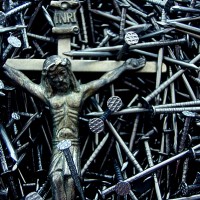
Jesus installs Kingdom priorities that redefine relationship as one by faith. 

Jesus had brothers and sisters–Mary’s other children fathered by Joseph.  But instead of telling Mary to go home to her eldest son for care and comfort, Jesus redefines her family—His family—in relation to faith.  Mary believed.  John, the beloved disciple, believed.  This common belief created a bond of relationship—of love.

This is the Church (or at least how it is supposed to be):  People related in love to one another by our common faith in Christ, our brother; people who have been brought into the family of God by Christ’s sacrifice; and people who call upon God as our Father in heaven. Kingdom priorities value faith over flesh. 

How great is the love the Father has lavished on us, that we should be called children of God! And that is what we are! (1 John 3:1)

How do we see Victory in Jesus’ Last Words here?  It is seen in a relationship of common faith, displayed in the Spirit’s bonding of one human heart to another through the love of Christ.

Continue Reading

Lent Day 34–Victory through Confession

Jesus answered him, “I tell you the truth, today you will be with me in paradise.” Luke 23: 43

How many of us long for that kind of direct reassurance?  I can’t begin to imagine what a comfort that must have been for the criminal who was hanging on a cross on one side of Jesus.  Faced with imminent death, he made a confession that Christ was King.  In his final moments of life, he heard the reassuring voice of Jesus offering words of hope beginning with, “I tell you the truth”…

  • Not a wish.
  • Not a dream.
  • Not a best guess.
  • Not a wild prediction.
  • Not statistics or betters’ odds.

Jesus responds to the criminal’s confession with truth that “today”…

  • Not, sorry you’re too late.
  • Not maybe next week.
  • Not maybe next year.

The truth is that today “you”…

Not everyone who is sneering and hurling insults will be with me—

but you will.

You will be with me in paradise.

All because of a sinner’s confession that Jesus was the King of the Jews—sinless and crucified.  But this was only one half of the story.  Read the whole account:

 Luke 23: 39 One of the criminals who hung there hurled insults at him: “Aren’t you the Christ? Save yourself and us!” 40 But the other criminal rebuked him. “Don’t you fear God,” he said, “since you are under the same sentence? 41 We are punished justly, for we are getting what our deeds deserve. But this man has done nothing wrong.” 42 Then he said, “Jesus, remember me when you come into your kingdom.” 43 Jesus answered him, “I tell you the truth, today you will be with me in paradise.”

Jesus has given us this truth: There is Victory in Confession of His Name.

Therefore whoever confesses Me before men, him I will also confess before My Father who is in heaven” (Matthew 10:32 NKJ).


Continue Reading

Lent Day 33–Victory through Forgiveness

We often think of the Cross as the place where our victory has been won.  Jesus’ Victory March is progressively revealed through His Seven Last Words, or statements from the Cross.

In Luke 23:34, “Jesus said, ‘Father, forgive them, for they do not know what they are doing.’ And they divided up his clothes by casting lots.”

Here are the first of Jesus’ Last Words—and interestingly, they’re about forgiveness. 
It’s also remarkable that of His Last Words, this is the only petition or request made of God the Father by His Son.
  • Not “Father, protect me.” 
  • Not “Father, take away my pain.” 
  • Not “Father, grant me peace.” 
  • Not “Father, reassure me of your love.”
  • Not “Father, help me understand your will.”
  • Not “Father, give me the strength to endure this.” 
  • Not wisdom, not healing, not helping, not any number of other beautiful personal requests. 
  • Definitely not “Father, make them pay!”
  • 

“Father, forgive them.”

Why might forgiveness be a necessary first battle of the ultimate victory?  For Jesus, forgiveness and the restored relationship with the Father formed the very essence of His mission. 

For the Son of Man came to seek and to save what was lost (Luke 19:10). 

 This is my blood of the covenant, which is poured out for many for the forgiveness of sins (Matthew 26:28).

If this was Jesus’ first Last Words, what does that say about the important role forgiveness plays in our lives?  What does it say about our fighting our forgiveness battle before we will ever realize true victory?

For many of us, our harboring unforgiveness toward God and others has become like a lead security blanket which simultaneously comforts us and weighs us down.  We carry the bitterness.  We carry the wounds.  We carry the hatred and the hurt.  We carry betrayals and insults.  We carry them all as baggage throughout our days because we’re afraid to let it all go. 

We know how we’ve been hurt and yet, Jesus’ petition for the Father to forgive us ought to give us the comfort we need to release it to Him.  Where God has forgiven it, shall we continue to cling to it?

Do you want to know the Victory of the Cross?  It all begins with forgiveness.

Continue Reading

Lent Day 32–Beginning of the Happy Ending

As we work our way into the last days of Lent, we look toward the finish line—which in one sense is the Cross and in another sense is far beyond it.  If the Cross was a window into eternity, this is the scene we would see: Revelation 5:1-14.  It’s a passage I love so much that if I had only one opportunity to preach in a lifetime, it would be this passage–the beginning of the happy ending.

Revelation chapter 5 depicts a moment of great despair as it seems as though all is lost, but then our hero arrives just in time to save the day.  It’s masterful storytelling on the part of the Apostle John who was given a glimpse into the very throne room of God.  John weeps because it seems as though every hope of things ever being made right have been thoroughly dashed.  At this climax of storytelling tension, the Lion of the tribe of Judah (the King of Kings, Jesus) arrives on the scene and reveals that it’s His sacrifice on the Cross that is the ultimate triumph.

David Wilcox wrote a song called Show the Way which you can view him performing on YouTube.  The lyrics—in part—speak of this kind of dramatic triumph of the love of God in Jesus Christ:

Look, if someone wrote a play just to glorify
What’s stronger than hate, would they not arrange the stage
To look as if the hero came too late he’s almost in defeat
It’s looking like the evil side will win, so on the edge
Of every seat, from the moment that the whole thing begins
It is…

Chorus:
Love who makes the mortar
And it’s Love who stacked these stones
And it’s Love who made the stage here
Although it looks like we’re alone
In this scene set in shadows
Like the night is here to stay
There is evil cast around us
But it’s Love that wrote the play…
For in this darkness Love can show the way

 As you continue walking on the Way of Holiness; as you find your way to the Cross, look to it and then beyond it–beyond the darkness and pain of this present world– and know that Love has shown the Way.

Continue Reading