From the NIV
Genesis 3:1 Now the serpent was more crafty than any of the wild animals the LORD God had made. He said to the woman, “Did God really say, ‘You must not eat from any tree in the garden’?” 2 The woman said to the serpent, “We may eat fruit from the trees in the garden, 3 but God did say, ‘You must not eat fruit from the tree that is in the middle of the garden, and you must not touch it, or you will die.'” 4 “You will not surely die,” the serpent said to the woman. 5 “For God knows that when you eat of it your eyes will be opened, and you will be like God, knowing good and evil.” 6 When the woman saw that the fruit of the tree was good for food and pleasing to the eye, and also desirable for gaining wisdom, she took some and ate it. She also gave some to her husband, who was with her, and he ate it. 7 Then the eyes of both of them were opened, and they realized they were naked; so they sewed fig leaves together and made coverings for themselves. 8 Then the man and his wife heard the sound of the LORD God as he was walking in the garden in the cool of the day, and they hid from the LORD God among the trees of the garden. 9 But the LORD God called to the man, “Where are you?” 10 He answered, “I heard you in the garden, and I was afraid because I was naked; so I hid.” 11 And he said, “Who told you that you were naked? Have you eaten from the tree that I commanded you not to eat from?” 12 The man said, “The woman you put here with me– she gave me some fruit from the tree, and I ate it.” 13 Then the LORD God said to the woman, “What is this you have done?” The woman said, “The serpent deceived me, and I ate.” 14 So the LORD God said to the serpent, “Because you have done this, “Cursed are you above all the livestock and all the wild animals! You will crawl on your belly and you will eat dust all the days of your life. 15 And I will put enmity between you and the woman, and between your offspring and hers; he will crush your head, and you will strike his heel.” 16 To the woman he said, “I will greatly increase your pains in childbearing; with pain you will give birth to children. Your desire will be for your husband, and he will rule over you.” 17 To Adam he said, “Because you listened to your wife and ate from the tree about which I commanded you, ‘You must not eat of it,’ “Cursed is the ground because of you; through painful toil you will eat of it all the days of your life. 18 It will produce thorns and thistles for you, and you will eat the plants of the field. 19 By the sweat of your brow you will eat your food until you return to the ground, since from it you were taken; for dust you are and to dust you will return.” 20 Adam named his wife Eve, because she would become the mother of all the living. 21 The LORD God made garments of skin for Adam and his wife and clothed them. 22 And the LORD God said, “The man has now become like one of us, knowing good and evil. He must not be allowed to reach out his hand and take also from the tree of life and eat, and live forever.” 23 So the LORD God banished him from the Garden of Eden to work the ground from which he had been taken. 24 After he drove the man out, he placed on the east side of the Garden of Eden cherubim and a flaming sword flashing back and forth to guard the way to the tree of life. (NIV)
Service Order
Welcome
Worship in Song: Great is Thy Faithfulness, Amazing Grace
Scripture Reading Genesis 3:1-24 (see above)
Message: Blessings for a Broken World
In today’s passage, we can see 4 blessings for a broken world:
(1) God __ ____ a deliverer (v 15)–the “protoevangelion”.
He promises to __ ____ in the gap.
He promises to __ ____ a deliverer.
He promises to __ ____ evil.
(2) God __ ____ for them (v 21).
(3) God __ ____ them from themselves (v 22).
(4) God __ ____ them from temptation to solve their own problems (v 23).
Response: Open the Eyes of My Heart
Benediction
Today’s worship in song is provided by Wyeth Duncan (Christ Church Lake Forest) and Becky Hunter (Village Church of Gurnee). Our message this morning is provided by Barbara Shafer from Christ Church Highland Park.
 Our worship in song and Scripture will be unified by this theme of hope and deliverance. Each week, we will have the privilege of hearing from different volunteers from area churches representing different Christian denominations. We hope to give patients, visitors, and the staff at the hospital a taste of various worship expressions ongoing at area churches in addition to opportunities for being encouraged by the Gospel each week.
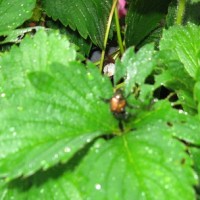 Japanese Beetles (right) are veritable eating machines, able to decimate entire plants, crops, and gardens. We’re in the height of Japanese Beetle season at present and there are ways of keeping them under control.
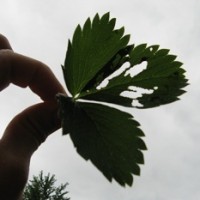 I do spray, but only when truly necessary—when things have gotten totally out of hand as they did one year that a bazillion of them were hanging out in a nearby linden tree, skeletonizing all the leaves (see damage to strawberry leaf at left). I’m not a big fan of spraying chemicals because they’re generally indiscriminate, killing friend and foe with equal force. Anything I can do to be more selective and less harmful, the better.
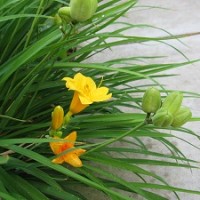 Of the frequently asked questions I received on the sales floor, people asked how to care for their daylilies. They’d bubble with excitement at seeing a big daylily that looked like this (right).
 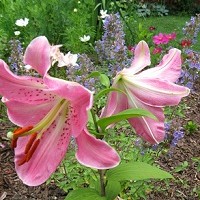 Plants have a legal name, if you will, that consists of a genus (larger group) and species (subgroup). Beyond that, certain cultivated varieties (cultivars for short) will have a name in quotes which makes it even more specific. The Oriental lily Lilium ‘Farolito’ shown here is a cultivar. Lilium x ‘Kiss Me Kate’ would be a hybrid lily denoted by an ‘x’ to show that it is a cross between a longiflorum lily (like an Easter lily) and an Asiatic lily.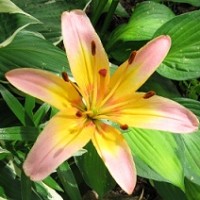
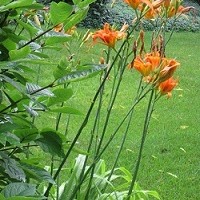 They grow differently in form—lilies (pictured on the left) are flowers emerging atop leafy stalks, daylilies (right) form clumps. They originate from different structures—lilies arise from bulbs, daylilies grow from fibrous root systems that will enlarge into spindle-like roots resembling tubers. Lily flowers are long lasting and open from the lower buds to the upper buds. When the buds have all opened, the flowering is completed for the year. Daylilies, on the other hand, have a short bloom—each lasting only a day, hence daylily, however the season of bloom may be quite extensive. Lily bulbs must be planted at a sufficient depth to protect them from the harsh winters, but not so deep that the plant must struggle through an endless stretch to reach the soil surface. Daylilies are planted so the crown is at the soil level with the fibrous roots and tuberous spindles are stretched out just below the soil surface. Lilies will grow larger clumps by growing increasing bulb sizes as well as by dropping bulbils (present after bloom in the leaf axils) off the stem onto the ground. Daylilies, depending on variety, can be downright invasive…emerging anywhere there’s an opportunity within the range of the mother plant.
 Offering sacrifices to God as a spiritual act of worship: Isn’t that the function of a priest in Old Testament language here in the New Testament? Doesn’t Scripture say that our bodies are the Temple of God (1 Corinthians 3:16)? By His Spirit dwelling in us, aren’t our bodies the place where God meets with us? If yes and Amen and Amen, then doesn’t it follow that when we serve God with our bodies as a spiritual act of worship, we are performing the function of a priest?
 I remember two instances in which the concept of pastor/priest hit home. The first one was when I was speaking with an individual who held a significant administration position in our community. He is Jewish and when he heard that I was in seminary, he asked if when I got out, I’d end up wearing one of those little white collars. We both laughed at the thought and I said that my denomination of church doesn’t do the little white collars…for that matter, women don’t do that kind of service. Then he asked, “Why go through with it then?” I responded, “I really don’t know. I guess, just because God is sending me.” Later on I thought, it doesn’t have to make sense to me. It’s not my role to pass judgment on God’s commission. My role is to do it.
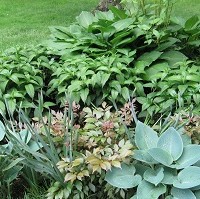 Pictured here are two instances of daffodil inter-planting. In the wet area of my yard, the hostas, astilbe, turtlehead have emerged and I can tuck the foliage behind these companion plants until it has completely died back. The foliage will continue to make food with plenty of sunlight and grow the bulk of the bulbs, then the summer perennials will fill the space left behind as the daffodils recede.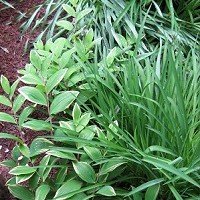
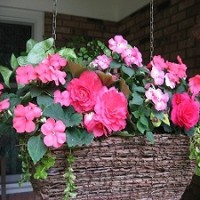 Since a container garden must share the same watering requirement and light level, taking care to select compatible companions is helpful. Consider these hanging baskets I made from two window boxes back to back. They are hung from their back loops by using chain link (painted with craft paint to reduce its sheen). The back window box has maidenhair fern, ivy, fittonia, and nepthytis and the front window box has creeping jenny/moneywort, coleus, tuberous begonia, and impatiens. Since I will never rotate these, the front box will get brighter light and the back box will be even more shaded and moist. I like the stewardship present as well since the maidenhair fern, ivy, fittonia and nepthytis are all houseplants that I’m summering outdoors and the creeping jenny was recycled from early spring pots. I enjoy creating beautiful things primarily from what I already have on hand, plus an added item or two. Beauty from season to season!
 Love the Lord your God…and your neighbor as yourself. Being in community and FOR one another may involve risking any of these:
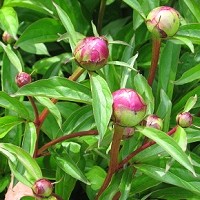 When I worked at Home Depot, I could guarantee this query at least a dozen times each weekend that the peonies were in bloom. Gardening has its share of pieces of Folk Wisdom and this isn’t one of them.
 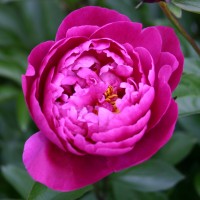 Peonies enjoy full to part sun, are heavy feeders, and come in singles and doubles as well a variety of colors. They can endure in the same location for decades and reward you with their beauty in the spring and their durable shrub-like foliage until the fall. They require some additional care with respect to planting depth and are best divided in the fall in order to bloom happily. They are some of the oldest cultivated plants for good reason—they are truly among the masterpieces of May.