How to Overwinter Tree Roses

Roses are among the most beloved plants.  Matchless for their variety of colors and fragrance and forms, roses have a beauty that makes their persnickety nature part of their charm.  Roses need special pruning and fertilizing and insect prevention, but they also need strict attention to their fall and winter care. (Please note update at the end 5.3.2013)

Last year, I took some photos as I was preparing to overwinter my rose.  My ‘Double Delight’ tree rose is even more demanding with regard to its care than bush roses I also grow in pots.

Here is how I overwinter my tree rose:

Step 1:  Cease fertilizing roses 2 months before overwintering.  The first killing frosts in my area are mid-October so an August 15th deadline gives two full months for my roses to wind down and become convinced that it’s really OK with me for them to go dormant for the winter.

Roses, for all their complicated care, have a strong desire to grow even into the frosts.  No fertilizer, no pruning, and full exposure to cold temperatures/frosts tell them that they need to rest now.  While they’re in their two-month cool down, I dig a trench in my compost pile (which is more like a pile of leaves than a true compost pile).  The trench will need to be big enough to accommodate the tree rose laying on its side and whatever other roses I’ve been growing in pots.

Step 2:  Once the hard frosts have hit a time or two, I can safely prune them.  The leaves and flowers often have a dull purplish tone to them showing that they have been exposed to sufficient cold.  Roses already know it’s time to shut down for the season, so when I prune them for the winter’s covering, they just accept it and don’t rebel against it by trying to grow some more.  They are obedient roses.  Tree roses get pruned differently than a bush rose so my photos will demonstrate their winter care.

All non-landscape roses have a “graft union” (place where the pretty rose variety was plugged into the sturdy root stock).  For bush roses, it is located at the ground level and this graft union can be covered with soil or mulch.  I’m particular to pine bark mini-nuggets because they still pour when frozen and stay put during the winter.  The added benefit is the way they become part of the spring/summer mulch when I wash them away from the graft union.

Tree roses are different.  A standard form or tree rose has a root zone, a tall stalk that’s part of the rootstock, and the graft union is at the top of the root stock.  Since the graft union is what needs protecting, covering the roots with mulch does no good whatsoever for preserving the graft union.
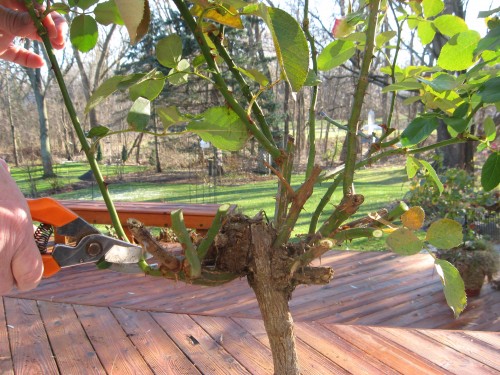
The knotty looking section with stems coming out is called the graft union.  With bush roses, I’m content to leave the canes about 12-18 inches long.  Not so with tree roses.  I clip them back to about 3 inches from the graft union.  Otherwise the new growth in the spring will be long and so heavy that the weak juncture will break off easily.  So I try to keep the spring growth compact.  It begins in the fall as I cut away the dead canes completely and the green canes get clipped to approximately 3 inches in length.  I use sharp pruning shears that have been treated with bleach so I don’t contaminate the rose for its winter rest.
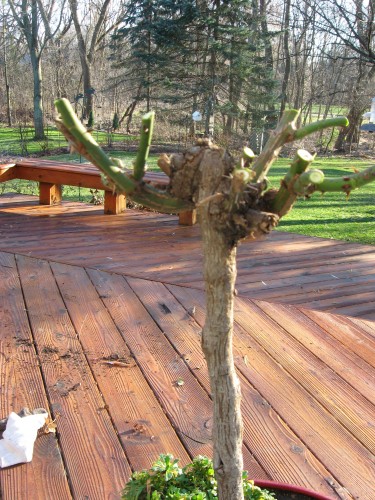
 

Step 3:  Once it is pruned, it looks very naked, I know.  But it will have less to try to maintain through the winter.  It may sound strange, but plants stay alive through the winter even as they are dormant.  If you have a large plant to try to keep alive, it will expend more of its stored food trying to keep it all alive…and it may end up killing the whole plant in the process.

You’ll notice I removed all the leaves which–at this point–will only be a source of disease inoculum for next year.  Even so, there may be some organisms on the canes, so I usually do one last spray of insecticide before wrapping it up.
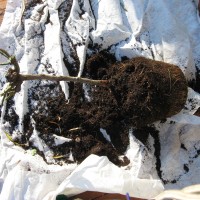


Step 4:  Wrapping the rose for winter storage (left).

While I could just bury the rose in its pot, I prefer to take it out of the pot so rain and melting snow can keep the root zone hydrated.  Both the roots and the graft union need to be protected and with a long stalk, it risks being broken in addition to frozen.  Therefore, I take the extra step of wrapping it in frost cloth.  Both air and water can permeate it, but the rose will stay substantially cleaner and will make it less attractive for mice than if it were just buried among all the leaves.  Furthermore, wrapping the whole rose in frost cloth helps to make its removal in the spring less likely to break anything, whether the stalk or the graft union/new buds.

 

Step 5: Cover the wrapped tree rose in the trench with leaves.  Of course, the trench I’ve already prepared in the back and the neatly wrapped rose don’t look too good in the photo with both roots and graft union ready to be covered.  Should the police wonder what I’m burying, we could always open it to reveal nothing but the rose inside.  Last year my son had a few laughs at my expense as we went out and buried it.  But, I got the last laugh this spring when I unearthed it.



Step 6:  In the early spring, I unearth my tree rose and place it in a sheltered spot.  If it’s too cold outside still, I’ll put it in the garage.  I don’t want to leave it in the compost pile and have the leaf buds begin to “break” in the dark.  But I also don’t want to have gone through significant effort to overwinter it only to have it zapped by a late winter cold snap.  Unearthing it while it’s still dormant will allow it to develop naturally as the weather improves.  I pot it up, water it, and as the daylengths increase and the buds swell and break, I begin to fertilize it again.

My “Double Delight” tree rose began to experience bud break soon after unearthing/repotting it and it produced blossoms that were absolutely stunning this year.  By way of note, the stalk will not get taller.  The height you buy it is the height the standard (stalk portion) will remain.  The growth will be in the canes that arise from the graft union.  Bush roses can be grown in pots and overwintered the same way or planted in the ground (in their frost-proof pots) for the winter.  Landscape roses such as “Carefree Wonder”, many rugosa roses, “The Fairy”, drift or “Knockout” roses do not need this special care since they are hardier and not grown as grafted plants.  If you love roses but hate the maintenance, these “own root roses” are good options to try.

But for those of us who desire tree roses, we don’t mind that they are higher maintenance plants.  These jewels among jewels of the garden are well worth the extra care they require.   There is something marvelous about a reward of such beauty after a long labor of love.  It’s kind of a nice reflection in nature of the same beauty and reward of the Christian life well-lived. 


==== Important update (5.3.2013) For the first time in the decade I’ve been overwintering my roses this way, this year my roses were eaten by voles (a type of mouse).  Each of them looked like they had been put in an electric pencil sharpener and gnawed to a point.  I am attempting to root them (since there was remaining root stock below the graft union).  I’m not sure how well that will work since the bark appears to have been stripped all the way to the cambial layer, but I’ll keep you updated.

(2013) So this year when I overwinter my roses, it will include using hardware cloth (wire mesh with 1/4″ holes) to keep the voles from breaking my heart again next year.   As I wrap them in hardware cloth, I’ll include photos of that too.

That was ineffective as the voles found their way in, so last winter (2016-2017) I kept it in the garage.  I watered it periodically with cold water and kept the lights on in the garage to provide a little heat on the coldest of nights.  The result was a resounding success.  Cutting it back just as shown in the earlier photos, I placed it outside after danger of frost (putting it on the front porch tucked next to the house, if frost threatens).  Here is how it turned out.  It will be spectacular when it blooms.  I also did some containerized bush roses that way and they’re every bit as ready to burst into bloom! 

 

Continue Reading

Chapel Worship Guide 10.21.2012

Service Order for 9:00 AM Sunday, October 21, 2012

Nemmers Family Chapel at Advocate Condell 

Welcome–Barbara Shafer, Christ Church Highland Park

Worship in Song with Carl Festin and Jean Gray, Village Church of Gurnee

Hymn 561:  Day by Day 

What the Lord Has Done in Me – Reuben Morgan

Hymn 11:  A Mighty Fortress 

Prayer– Bill Slater, http://billslaterministries.org

Scripture Reading (NIV): 2 Samuel 7:8 “Now then, tell my servant David, ‘This is what the LORD Almighty says: I took you from the pasture and from following the flock to be ruler over my people Israel. 9 I have been with you wherever you have gone, and I have cut off all your enemies from before you. Now I will make your name great, like the names of the greatest men of the earth. 10 And I will provide a place for my people Israel and will plant them so that they can have a home of their own and no longer be disturbed. Wicked people will not oppress them anymore, as they did at the beginning 11 and have done ever since the time I appointed leaders over my people Israel. I will also give you rest from all your enemies. “‘The LORD declares to you that the LORD himself will establish a house for you: 12 When your days are over and you rest with your fathers, I will raise up your offspring to succeed you, who will come from your own body, and I will establish his kingdom. 13 He is the one who will build a house for my Name, and I will establish the throne of his kingdom forever. 14 I will be his father, and he will be my son. When he does wrong, I will punish him with the rod of men, with floggings inflicted by men. 15 But my love will never be taken away from him, as I took it away from Saul, whom I removed from before you. 16 Your house and your kingdom will endure forever before me; your throne will be established forever.'”

Sermon: “The Past, Present, Future, and Eternal King”—by Bill Slater

Songs of Response:

Hymn 85:  Crown Him with Many Crowns

Son of David – written and performed by Carl Festin

Benediction — Bill Slater

Continue Reading

What to Do About Hydrangeas?

Hydrangeas can be confusing at nearly every season.   Fall confusion produces as many questions as spring confusion.

In the fall, people in the northern United States look at their hydrangeas and wonder, “Now what?”

Winter is coming. 

Do I cut my hydrangeas back? 

Do I let them go just as they are? 

Everyone has advice.  I’ll offer you mine and also point you to some really excellent web sites on hydrangeas (look for the links).

Most of the confusion can be resolved by knowing which hydrangea you have and where you live (check this hardiness zone map).  One web site that has a nice, easy-to-understand description has a Hydrangea Identification page.  It will help you to discern whether or not yours is:

    1. a big leaf (H. macrophylla, also called Mophead or Lace Cap) which is commonly offered in various blue and pink forms and often can be color changed by altering soil pH.
    2. oakleaf (H. quercifolia) which is native to the southeastern US,
    3. Peegee (H. paniculata) which is native to Japan/China and has flowers that are elongated panicles rather than rounded,  or
    4. Annabelle’ type (H. arborescens) which have the large white ball-like flowers.  ‘Annabelle’ is the most famous of this class of hydrangea.

You’ll notice I listed them all as H. (which stands for Hydrangea) and then a different name second.  That’s because like a family all has the same last name and your first name distinguishes who in your family is being discussed, so the Latin second name refers to a specific species within a genus (the name Hydrangea).  How you care for hydrangeas depends on how hardy yours is and whether it characteristically blooms on old wood (last year’s growth) or new wood (current year’s growth).  In any case, I stop all fertilizing of hydrangeas and roses after August 15th to convince these plants to enter dormancy.

Among the ones that bloom on new wood are Endless Summer,  H. paniculata such as Limelight, and H. arborescens “Annabelle”.  Because these bloom on new wood, the current season’s growth, they can be pruned at any time, although late fall (after a few hard frosts) ensures they won’t try to continue putting out new growth and instead will enter dormancy.  Endless Summer will produce better/ more profuse blossoms if the spent flowers are removed.  If your Endless Summer are still smaller in size, you can just let them go through the winter, no pruning needed at all.  If yours are larger, you can prune them back, but it’s not necessary.  The grower has a nice winter care guide.    “Annabelle” is prized for its large white blossoms, but it can be cut down severely in the fall which helps it to maintain a better shape and sturdier habit for the following year (unless you prefer your Annabelle flowers bent over into your mulch, but frankly she deserves better than facedown in the dirt).

Old wood:  most of the other macrophylla (big leaf) and quercifolia (oak leaf) types must be pruned immediately after flowering as by fall, they’ve set their flower buds.  Lilacs, azaleas, rhododendrons, and many viburnums do the same thing.  Pruning these in the fall will cut off all the flower buds.  So how do I overwinter my macrophylla “Nikko Blue” and some so-called Color Change that aren’t actually hardy in my area?  I bought all of these knowing that they are marginally hardy and would die back down to their roots in Chicagoland.  I brought back my “Nikko Blue” from New Jersey many years ago as a sentimental family favorite and my “Color Change” were a carryover from some pots I’d planted at church.  I couldn’t bear to throw them out when I switched the pots to mums and winter evergreens and decided to give these hydrangeas a whirl in my garden.  The first year in the ground neither of these bloomed because they died too far back in the winter.  While hydrangea foliage is attractive enough, it misses the whole point of the beauty of the flowers!  I learned my lesson so now…

This is how I overwinter my marginally hardy macrophyllas:


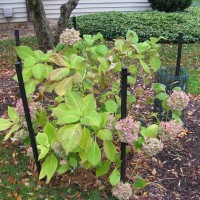
Step 1:  I stake the area around my hydgrangea while the ground is not frozen (left).  But covering hydrangeas before they go dormant doesn’t help them.  Make sure that there have been a few hard frosts before continuing.


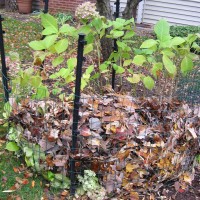
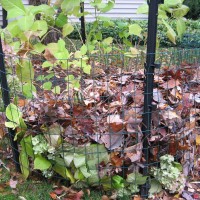
Step 2:  I surround my plant with rabbit fencing to create a corral (right) and begin to place the last of the fall leaves around the base of the plant as we get hard frosts.


Step 3:  I slowly and gently pile leaves from the center out to the tips of the plant to bend the stalks without breaking them (left).

Eventually the entire plant will be covered with a layer of leaves and I put some netting over the top to keep the leaves from blowing away during the winter.  Of course, this makes a mess for removal in the early spring time after the coldest of winter days have passed.  I remove the stakes, unwind the corral, and then the leaves used as cover slide easily from the center outward.  The leaves may be slimy and partly decomposed, but they’ve served their function of blanketing the stalks through the coldest winter days.

While this method has worked beautifully to have abundant flower buds survive a Chicagoland winter, it’s important to note that I remove the leaves before the buds “break” (start to unfurl) so that the leaves don’t rot and so the buds don’t send out tender new growth to get zapped by late frosts.  I keep my eyes on the forecast because after uncovering the bud-filled branches, I may need to cover them with frost cloth if we are due to dip below their hardiness.  Once the leaves are removed, the buds will need to adjust to the unsheltered conditions…just as they would in areas of the country where they are fully hardy.

In the spring, after I see where the strongest growth is maintained and where the deformed (damaged) buds begin, I prune the stalk into the strong growth section. This ensures that I will have the maximum number of flower buds, but not have the tips stunted by damaged growth.  It may seem like a lot of work to go through, but the reward is well worth it if you’re trying to grow certain macrophylla hydrangeas at the northern end of their hardiness.

The newer macrophylla varieties like Endless Summer have achieved great popularity because they have all the benefits of the beauty of the big leaf varieties without the hassle of overwintering.  They’re well worth the price in both beauty and hardiness.  But now, at least, you have an option to try if you’re trying to grow macrophyllas north of their normal hardiness.


Continue Reading

An Amazing Remembrance

1 Corinthians 11:23 For I received from the Lord what I also passed on to you: The Lord Jesus, on the night he was betrayed, took bread, 24 and when he had given thanks, he broke it and said, “This is my body, which is for you;  do this in remembrance of me.” 25 In the same way, after supper he took the cup, saying, “This cup is the new covenant in my blood; do this, whenever you drink it, in remembrance of me.” 26 For whenever you eat this bread and drink this cup, you proclaim the Lord’s death until he comes. 27 Therefore, whoever eats the bread or drinks the cup of the Lord in an unworthy manner will be guilty of sinning against the body and blood of the Lord. (NIV)

Do this in remembrance of me.”

On the very night He would be betrayed by those He came to save, the Lord Jesus gave us a way of remembering Him. 

 This way remembers His death.

Most of us cherish memories of the life of our loved ones—happy times we had together, favorite places we would go, vacations we took, laughter we shared, or hobbies we enjoyed with them.

What does Jesus want? 

He wants us to cherish His death—indeed, to proclaim it.

Isn’t it strangely beautiful?  Rather than asking us to remember happy things we could only know second-hand from reading Scripture, the Lamb of God—Jesus Christ—shows us that His sacrificial death is for us, in whatever age we live.

In a sense, we transcend time because we were there in the betrayal as far back as Eden. 

We were there in spirit the night Jesus was betrayed. 

We were alongside those shouting, “Crucify Him!,” not knowing what we were doing.   

We share in the inheritance of sinners.

But followers of Christ also share in salvation’s beautiful hope by the blood of the Lamb: His death for us.

So, Jesus calls us to communion with Him as we share the bread and cup and remember His death.

While they were eating, Jesus took bread, gave thanks and broke it, and gave it to his disciples, saying, ‘Take and eat; this is my body.’” (Matthew 26:26)

In the Garden of Eden, we took and ate…and received separation from God.  In the Passover, Jesus says, “Take and eat” and by the New Covenant in His blood, He restores us to fellowship with our Father.  Come to Jesus’ table and come to the Cross where love and judgment meet.

Unlike some pilgrimage to a distant holy site, this coming home to our Father is inward. We transcend our generation through a timeless fellowship meal during which we proclaim Jesus’ death.

It’s a spiritual pilgrimage to the heart where His death whispers salvation to all who hear and believe.  This is My body, broken for you.  This is My blood, shed for you.  A simple act.  A simple meal.  Yet what an amazing remembrance!

======

Questions:

  • Imagine having to pack up for a trip to a designated location once a year to worship God.  How is the Passover meal more accessible to everyone in the world?
  • Are there ways in which the concept of eating the body and drinking the blood of Christ seems repulsive?  Why do we feel that way?
  • The Passover Meal we celebrate as Communion is sometimes called The Eucharist (coming from the Greek word meaning “give thanks” and closely related to the word meaning “grace”).  Ponder the many ways in which the terms Eucharist and Communion are appropriate.

=====

For further study:  Genesis 3, John 6

Continue Reading

Chapel Worship Guide 10.14.2012

Service Order for 9:00 AM Sunday, October 14, 2012

Nemmers Family Chapel at Advocate Condell


Welcome–Barbara Shafer, Christ Church Highland Park

Scripture Reading: Isaiah 11:1 A shoot will come up from the stump of Jesse; from his roots a Branch will bear fruit. 2 The Spirit of the LORD will rest on him– the Spirit of wisdom and of understanding, the Spirit of counsel and of power, the Spirit of knowledge and of the fear of the LORD– 3 and he will delight in the fear of the LORD. He will not judge by what he sees with his eyes, or decide by what he hears with his ears; 4 but with righteousness he will judge the needy, with justice he will give decisions for the poor of the earth. He will strike the earth with the rod of his mouth; with the breath of his lips he will slay the wicked. 5 Righteousness will be his belt and faithfulness the sash around his waist.

Romans 15: 5 May the God who gives endurance and encouragement give you a spirit of unity among yourselves as you follow Christ Jesus,6 so that with one heart and mouth you may glorify the God and Father of our Lord Jesus Christ. 7 Accept one another, then, just as Christ accepted you, in order to bring praise to God. 8 For I tell you that Christ has become a servant of the Jews on behalf of God’s truth, to confirm the promises made to the patriarchs 9 so that the Gentiles may glorify God for his mercy, as it is written: “Therefore I will praise you among the Gentiles; I will sing hymns to your name.” 10 Again, it says, “Rejoice, O Gentiles, with his people.” 11 And again, “Praise the Lord, all you Gentiles, and sing praises to him, all you peoples.” 12 And again, Isaiah says, “The Root of Jesse will spring up, one who will arise to rule over the nations; the Gentiles will hope in him.”

Prayer– Barbara Shafer

Sermon: “A Righteous Branch of Jesse”—Barbara Shafer

In Isaiah 11:1-5, we see 4 secrets revealed about who the Messiah will be.   We see His:

  1. ancestry…the stump of Jesse (v. 1)
  2. anointing (v 2)
  3. attributes reflecting His character (v.3-4)
  4. actions of adjudication (v.3-5)

Benediction — Barbara Shafer

Romans 15:13 May the God of hope fill you with all joy and peace as you trust in him, so that you may overflow with hope by the power of the Holy Spirit.

Continue Reading

Chapel Worship Guide 10.7.2012

Service Order for 9:00 AM Sunday, October 7, 2012

Nemmers Family Chapel at Advocate Condell


Welcome–Nathan Clayton, Christ Church Lake Forest

Songs of Praise

Scripture Reading: Genesis 49:8 “Judah, your brothers will praise you; your hand will be on the neck of your enemies; your father’s sons will bow down to you. 9 You are a lion’s cub, O Judah; you return from the prey, my son. Like a lion he crouches and lies down, like a lioness– who dares to rouse him? 10 The scepter will not depart from Judah, nor the ruler’s staff from between his feet, until he comes to whom it belongs and the obedience of the nations is his. 11 He will tether his donkey to a vine, his colt to the choicest branch; he will wash his garments in wine, his robes in the blood of grapes. 12 His eyes will be darker than wine, his teeth whiter than milk.

Matthew 2:1 After Jesus was born in Bethlehem in Judea, during the time of King Herod, Magi from the east came to Jerusalem 2 and asked, “Where is the one who has been born king of the Jews? We saw his star in the east and have come to worship him.” 3 When King Herod heard this he was disturbed, and all Jerusalem with him. 4 When he had called together all the people’s chief priests and teachers of the law, he asked them where the Christ was to be born. 5 “In Bethlehem in Judea,” they replied, “for this is what the prophet has written: 6 “‘But you, Bethlehem, in the land of Judah, are by no means least among the rulers of Judah; for out of you will come a ruler who will be the shepherd of my people Israel.'”

Prayer– Nathan Clayton

Sermon: “A Promised King and Descendant of Judah”—Nathan Clayton

Song of Response

Benediction/Closing Prayer– Nathan Clayton


Continue Reading

The Best Kind of Healing

Whenever we discuss healing in my Christian Cancer Survivors support group, we can count on a lively discussion.  What is healing we can have confidence in?

Jesus taught in the synagogues, and Scripture tells us that everyone praised him. When He went to Nazareth, where he had been brought up, He stood up to read the scroll of the prophet Isaiah.  The Bible says that unrolling it, he found the place where it is written:

 “The Spirit of the Sovereign LORD is on me, because the LORD has anointed me to preach good news to the poor. He has sent me to bind up the brokenhearted, to proclaim freedom for the captives and release from darkness for the prisoners, to proclaim the year of the LORD’s favor.” Isaiah 61:1-2a

With His first Advent, Jesus proclaimed the year of the LORD’s favor—to heal, free, and save.  In earthly time, He healed every kind of sickness and disease (Matthew 4:23-24) proving He is Messiah.  Earthly healing means Jesus binds up our broken hearts and may even free us from cancer or other diseases, perhaps for the remainder of our lifetime.

But true confidence comes in healing that is spiritual and eternal.  This healing is higher and better than any earthly healing.

Interestingly, in Luke’s account (Luke 4:18-19) Jesus stopped reading before quoting the rest of Isaiah 61:2 in which God promises eternal healing.  This would not be fulfilled until after the Resurrection.

“[A]nd the day of vengeance of our God, to comfort all who mourn,  and provide for those who grieve in Zion– to bestow on them a crown of beauty instead of ashes, the oil of gladness instead of mourning, and a garment of praise instead of a spirit of despair. They will be called oaks of righteousness, a planting of the LORD for the display of his splendor.”  Isaiah 61:2b-3

Because of what Jesus did during His first Advent—dying for our sins on the Cross, rising from the dead, and saving the world —there will be a Second Advent (i.e. the day of vengeance).  Our Savior will return—not to save the world, but to separate us basis what we did with His first Advent (Matthew 25:31-46, John 12:47-48).

At Jesus’ return, the faithful will be a righteous display of God’s splendor through eternal healing made possible by Christ.  New bodies never again afflicted by disease or pain.  Vindication.  A crown of beauty.  Gladness.  Praise.  He will wipe away every tear!  For those who have drawn near to God through faith in Jesus Christ, His Second Advent will bring final eternal healing—a glorious day indeed!

Questions for meditation:

  • What healing are you looking for, earthly or eternal?
  • What have you done with Jesus’ first Advent in preparation for His imminent return?
  • Will His Second Coming be a glorious day of eternal healing for you, or a day of vengeance upon persistent rejection of Jesus’ saving work?

For additional study:

Revelation 20:11-13–

Revelation 20:11 Then I saw a great white throne and him who was seated on it. Earth and sky fled from his presence, and there was no place for them. 12 And I saw the dead, great and small, standing before the throne, and books were opened. Another book was opened, which is the book of life. The dead were judged according to what they had done as recorded in the books. 13 The sea gave up the dead that were in it, and death and Hades gave up the dead that were in them, and each person was judged according to what he had done.

Malachi 4:1-2–

Malachi 4:1 “Surely the day is coming; it will burn like a furnace. All the arrogant and every evildoer will be stubble, and that day that is coming will set them on fire,” says the LORD Almighty. “Not a root or a branch will be left to them. 2 But for you who revere my name, the sun of righteousness will rise with healing in its wings. And you will go out and leap like calves released from the stall.

Continue Reading

“No King But Caesar”

One of the saddest statements in the Bible is found in John 19:15– 

“But they shouted, “Take him away! Take him away! Crucify him!”

“Shall I crucify your king?” Pilate asked.

“We have no king but Caesar,” the chief priests answered.


We have no king but Caesar.” 

It’s the grim echo of 1 Samuel 8:7 “And the LORD told [Samuel]: “Listen to all that the people are saying to you; it is not you they have rejected, but they have rejected me as their king. “

I recently had a respectful discussion with someone who asserted that one political party in the United States was more in line with biblical teaching, especially with respect to care for the poor and issues of social justice.  

I answered the assertion with this statement:

But the result of political social tinkering is that masses of people no longer seek God or the Church to care for the poor…where they might find Jesus in the process. The government drives a wedge between people and their God.”

In my book, good and evil don’t fall along party lines.  As I see it, both parties agree that caring for the poor is a good thing to do.  We may disagree about what truth we’re seeking or what true justice is.  And I’d say that we definitely have a disagreement about the best way to go about truly helping the poor and the oppressed. 

Perhaps we have different goals in mind altogether.  Our solution for how to care for the poor is intimately related to the question of which god we serve?   Do we serve the God of Abraham, Isaac, and Jacob or do we have no king but Caesar?

This conversation started my prayerful thinking about what the Bible says about care for the poor and social justice as well as what it says about the purpose and role of human forms of government.

Are people in America looking to the government instead of to the Church in their times of need? 

Increasingly, that answer is “Yes.” 

 Is that the way God designed life to be?

I am personally convinced that God wanted His people to do the job of caring for the poor as a reflection of our faith.

I am drawn to the idea that God is looking for a big, brawny Church—working so hard spiritually—that it doesn’t have time to become rich, fat, or lazy, waiting for people to enter the opulent, architectural wonders to be fed off the pastor’s spiritual plate, along with everybody else.

The Church is not supposed to be a feeding trough with clever branding and nice carpeting. 

Isn’t God’s intent that the needs of people draw them to…God…who provides for every need? 

Then God’s Church does what He designed it to do: be a place where people have come (on account of their physical, spiritual, and emotional needs) but in the process of being satisfied, they will meet God, learn about Him, and find salvation in Jesus Christ–and also satisfy their greatest need for all eternity.

What, then, is the role of government?

The Bible is clear on this.

Romans 13:1 Everyone must submit himself to the governing authorities, for there is no authority except that which God has established. The authorities that exist have been established by God. 2 Consequently, he who rebels against the authority is rebelling against what God has instituted, and those who do so will bring judgment on themselves. 3 For rulers hold no terror for those who do right, but for those who do wrong. Do you want to be free from fear of the one in authority? Then do what is right and he will commend you. 4 For he is God’s servant to do you good. But if you do wrong, be afraid, for he does not bear the sword for nothing. He is God’s servant, an agent of wrath to bring punishment on the wrongdoer. 5 Therefore, it is necessary to submit to the authorities, not only because of possible punishment but also because of conscience.

The government protects the public interest by maintaining law and order, bringing punishment upon wrongdoers, and being the human instruments of God.  Government is completely legitimate.  But note that while it is legitimate and an instrument of God, (1) it is not the Church, (2) its role is not to care for the poor, (3) it is not to substitute as Messiah, and (4) it is not to separate people from their God.

When we see the limits, we can embrace a lean and muscular government—one like a marathon runner—an institution so focused on the finish line of civilization, humble restraint, and shepherding law and order that it has neither the time nor the desire to grow fat and lazy.  A Jabba the Hutt government with an insatiable appetite for power and money isn’t what God had in mind.

What did God intend in giving us both a Church and a Government?  Two institutions, each doing their job and not trying to do each other’s job, forsaking their own job in the process.

Sadly, as people look to the government as a place where all their needs are met, the Church’s unique role is diminished and people no longer seek God.  The consequence of this is hardening of people’s hearts toward helping the poor as a reflection of their faith.  “Oh, let the government do it.  That’s why we pay taxes,” becomes the cop-out response of a people who have lost sight of God’s ability to provide for people.  “Take from the rich and give to the poor” becomes the mantra of those who have no king but Caesar, clearly not knowing that if God wanted the poor to be rich, He has wealth, power, and opportunity to accomplish it without human help.

Therefore, both miss the point that sometimes people have needs SO THE CHURCH WILL MEET THEM with the goal that they’ll meet Jesus and be fed spiritually for eternity.  Some people are designated “grace recipients” …if the Church is doing its job (and not submitting to the concept of government enablers to do our job for us) or shirking its God-given role.

Yes, I believe the government drives a wedge between people and their God.  Because one thing is for sure: a government without limits is a counterfeit king with an appetite that is never satisfied.  Tragically, those who are hungry will never be satisfied in the long haul, if they seek to be filled by mere government hands.

Isaiah 55:1 “Come, all you who are thirsty, come to the waters; and you who have no money, come, buy and eat! Come, buy wine and milk without money and without cost. 2 Why spend money on what is not bread, and your labor on what does not satisfy? Listen, listen to me, and eat what is good, and your soul will delight in the richest of fare. 3 Give ear and come to me; hear me, that your soul may live. I will make an everlasting covenant with you, my faithful love promised to David. 4 See, I have made him a witness to the peoples, a leader and commander of the peoples. 5 Surely you will summon nations you know not, and nations that do not know you will hasten to you, because of the LORD your God, the Holy One of Israel, for he has endowed you with splendor.” 6 Seek the LORD while he may be found; call on him while he is near. 7 Let the wicked forsake his way and the evil man his thoughts. Let him turn to the LORD, and he will have mercy on him, and to our God, for he will freely pardon.”

Have we rejected God as king? 
 Do we have no king but Caesar? 
For a wide swath of America, sadly, the answer is a grim resounding, “Yes.” 
Not for me.  My King is still on the throne.
Continue Reading

Jesus Changes Everything

Many of us long for significance, to have a legacy that lives on long after we die.  Consider the story of a man barely thirty years old who began a three year ministry during which He would radically impact the course of every life for all time.  Jesus Changes Everything.

Jesus went to a synagogue in Nazareth as He usually did, was handed the scroll of the prophet Isaiah and began reading,

The Spirit of the Lord is on me, because he has anointed me to preach good news to the poor. He has sent me to proclaim freedom for the prisoners and recovery of sight for the blind, to release the oppressed, to proclaim the year of the Lord’s favor.” Then he rolled up the scroll, gave it back to the attendant and sat down. The eyes of everyone in the synagogue were fastened on him, and he began by saying to them, “Today this scripture is fulfilled in your hearing.”  All spoke well of him and were amazed at the gracious words that came from his lips. “Isn’t this Joseph’s son?” they asked. (Luke 4:18-22)

Jesus proclaimed He is the Messiah, the fulfillment of prophecy, that God’s Spirit is upon Him as He embarks upon God’s mission of setting all things right!  (Receiving your political party’s nomination for a presidential run elicits cheers, balloons dropping, confetti, and large font headlines, yet it pales against Jesus’ bold statement.)

I am the Messiah, Jesus announces!  One would expect instant celebrity status.  Instead, the pronouncement is met with a mighty thud because—already—they did not believe him.

Yeah, Jesus speaks gracious words, but…wait a minute, isn’t this the son of Joseph the carpenter? 

Thud! 

Reverberating through the centuries, what we believe about Jesus—the God-Man who changes everything—has eternal consequences.

Who is Jesus?  Son of God and Messiah, or just another carpenter’s son? 

Jesus fulfilled all prophecy regarding the coming Messiah and rose from the dead to prove He is the Savior, yet He is met—even today—with a spectrum from faith to rejection.  When the trumpet sounds and He returns as King of Kings and Lord of Lords, eternity will forever attest that what we believe about Jesus Changes Everything!

 ***

Who do you say Jesus is? How does this change your definition of success or significance?

Read also: Matthew 16:13-17, Matthew 24:30-31, Mark 14:61-62

Continue Reading

Chapel Worship Guide 9.30.2012

Service Order for 9:00 AM Sunday, September 30, 2012

Nemmers Family Chapel at Advocate Condell

Welcome–Barbara Shafer, Christ Church Highland Park

Today’s worship features Libertyville Covenant Church 

Opening Prayer

Greeting

Songs of Praise:

  • “All Creatures of Our God and King” (St. Francis ofAssisi, Draper, Milligan, Crowder)
  • “That’s Why We Praise Him” (Walker)

Prayer of Confession

Assurance of Pardon

Song of Response:  “Give Us Clean Hands” (Hall)

Scripture Reading:  Deuteronomy 18:15 The LORD your God will raise up for you a prophet like me from among your own brothers. You must listen to him. 16 For this is what you asked of the LORD your God at Horeb on the day of the assembly when you said, “Let us not hear the voice of the LORD our God nor see this great fire anymore, or we will die.” 17 The LORD said to me: “What they say is good. 18 I will raise up for them a prophet like you from among their brothers; I will put my words in his mouth, and he will tell them everything I command him. 19 If anyone does not listen to my words that the prophet speaks in my name, I myself will call him to account.

John 12:44 Then Jesus cried out, “When a man believes in me, he does not believe in me only, but in the one who sent me. 45 When he looks at me, he sees the one who sent me. 46 I have come into the world as a light, so that no one who believes in me should stay in darkness. 47 “As for the person who hears my words but does not keep them, I do not judge him. For I did not come to judge the world, but to save it. 48 There is a judge for the one who rejects me and does not accept my words; that very word which I spoke will condemn him at the last day. 49 For I did not speak of my own accord, but the Father who sent me commanded me what to say and how to say it. 50 I know that his command leads to eternal life. So whatever I say is just what the Father has told me to say.”

Prayer

Sermon: “A Prophet Like Moses”

Closing Song:  “Word of God Speak” (Millard, Kipley)

Benediction/Closing Prayer

Continue Reading